
By Dom Zef Simoni
Part seven
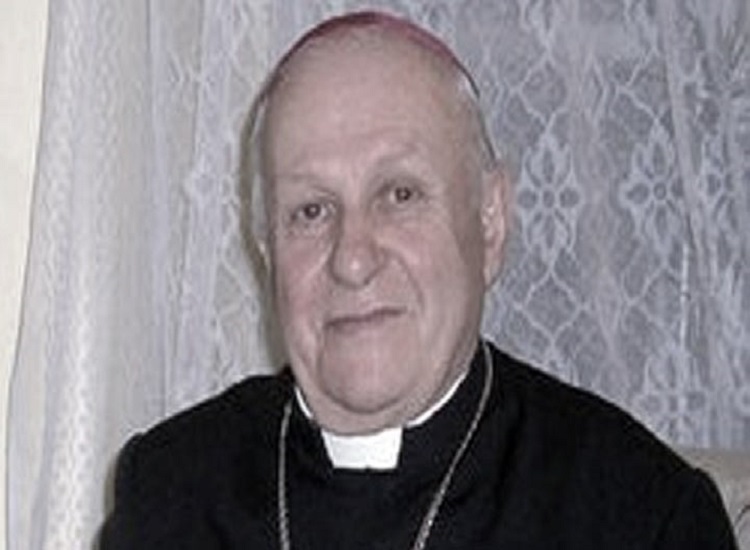
Memorie.al /publishes an unknown study by Dom Zef Simoni, entitled “The Persecution of the Catholic Church in Albania from 1944 to 1990”, where the Catholic cleric, originally from the city of Shkodër, who suffered for years in the prisons of Enver Hoxha’s communist regime and was consecrated as Bishop by the head of the Holy See, Pope John Paul II, on April 25, 1993, after describing a brief history of the Catholic Clergy in Albania, dwells extensively on the persecution suffered by the Catholic Church under the communist regime, from 1944 to 1990. Dom Zef Simoni’s full study, starting from the attempts by the communist government in Tirana immediately after the end of the War to separate the Catholic Church from the Vatican, initially by preventing the return to Albania of the Apostolic Delegate, Archbishop Leone G.B. Nigris, after his visit to the Pope in the Vatican in 1945, and subsequently with pressures and threats against Monsignor Frano Gjini, Gaspër Thaçi, and Vinçens Prenushi, who firmly opposed Enver Hoxha’s “offer” and were consequently executed by him, as well as the tragic fate of many other clerics who were arrested, tortured, and sentenced to imprisonment, such as: Dom Ndoc Nikaj, Dom Mikel Koliqi, Father Mark Harapi, Father Agustin Ashiku, Father Marjan Prela, Father1 Rrok Gurashi, Dom Jak Zekaj, Dom Nikollë Lasku, Dom Rrok Frisku, Dom Ndue Soku, Dom Vlash Muçaj, Dom Pal Gjini, Fra Zef Pllumi, Dom Zef Shtufi, Dom Prenkë Qefalija, Dom Nikoll Shelqeti, Dom Ndré Lufi, Dom Mark Bicaj, Dom Ndoc Sahatçija, Dom Ejëll Deda, Father Karlo Serreqi, Dom Tomë Laca, Dom Loro Nodaj, Dom Pashko Muzhani, etc.
Continued from the previous issue
The Onslaught
He did not need to conquer lands like the sultans. He was quenched in a bloodthirsty fanaticism that never allowed him to think, but only to act and to curse the voice with a great shout, to be the herald of hell. And he went and searched the ditches of Albania and gathered them near himself, and then, like manure that the earth needs, he scattered them immensely, without the science of virtue. And, to praise himself and to curse others, he programmed the subject in his own head. He curses everything: good individuals who have breadth of mind and goodness of heart, he curses classes, states, great powers, the most beautiful realities, and he even had an issue with Heaven that is above all contingencies. He had an issue with the Absolute. This figure, which had much work, continuously appeared, filled with the troubles and whims of his successes. Without discussions, but issuing orders one after another, like arrows in old wars and bombardments in the new ones, he did everything to vent and rage, this man who did not want any contradiction, a quality of people with negative passions.
He had little time to be alone. Not the time that two categories of people needed – and these are saints and geniuses—but the time needed even by those who work against their conscience. A brief solitude made him have everything of his own: he was born to cause disaster. In order not to get confused, because he needed some justification, perhaps even towards himself, he divided things into good and bad. “Science,” he would say, “is good. So is work.” But when working, his ideas were not controlled, while those of others were, without any exception. He did not accept contradictions of any kind. He removed the heads. “Who has abandoned the homeland?” he would say. “Who will fix it? I will!” What are the causes, the sources? What is the objective reality? Enver was doing a great job, shaking the foundations of reality, introducing the darkness of violence and transforming everything into heart enmity, but the life of the dictatorship made him rejoice, as he was also distinguished as the lay instrument of Heaven, in this earthly terrain.
After having praised, for more than twenty years, forty deceased Catholic priests, starting from Buzuku up to Gjeçovi, in his own way – whom if they were alive, he would have done worse to them than those whose heads he cut off – he fell like a wolf among the sheep. Having science as a form and work as a system of slavery, this man of gossip, of division, was opening spring in his own sky, this idol of cliques who was making himself an altar, this big brother of Nero, Diocletian, Sa’di, Lenin, Stalin, Mao Zedong, Pol Pot, Fidel Castro, and so many others who have drunk the blood of nations, he kept the day of February 6, 1967, which he would mention in his decree speech, raising his head: “Let’s latch onto the mountains and hills…”!
And he continued the words: actions, people, revolutionary youth, lemon, oranges, olives, Riviera, flower gardens, as in a pantheistic paradise. This was the first line related to this science and this work. The second line: a stormy announcement, bringing out with splashes, with drool and passion, the words: “War against backward customs and religious prejudices.” Nothing more once: a spark. A small spark of dictatorship that ignites a great fire. His wicked work, the bad Chinese connection, a raging Cultural Revolution! Monkey business with quotes, ribbons, with bursts of madness. The skies of this Albania were changing: Christianity, Islam, and Atheism. An Atheist sky over this land. The first atheist state in the world. Land that Enver made crooked, air that his mouth fouled.
The Cultural Revolution
February 15, 1967, is the date of the beginning of the Revolution in Shkodra and throughout all of Albania. At 10:00 AM, the posting spots and everywhere on the streets were filled with large announcements. Groups of young men and women, holding rolled sheets, brushes, and pots of glue for pasting, around 12:00 PM, approached the Cathedral, the Franciscan Church of Gjuhadol, all the churches and mosques of the city; they opened the sheets titled “Lightning Sheets” (similar to the Chinese dazi bao) and placed them on the doors of the churches. They were filled with the terms of the time, with the sharp phrases of diabolic and crude content, against religion. “Religion has played a reactionary role, the Vatican is the center of obscurantism,” were the words of the sheets and the government. They wrote: “Clerics! The people call on you to hand over the churches, the cells (residences), and everything. Enough of your lies. Embrace work and earn bread by the sweat of your brow. Enough of living by deceit. The people do not want you. The youth do not want you!”
I was in the office, and from the large window, I saw groups of young men and women at the church door, which was closed, and a few people who had approached to read them. The people were increasing. The Monsignor, who immediately learned of this movement, calm and composed, with great seriousness, saw the great danger.
The Bishop, weighing his eyes under the black glasses he wore, seemed to dispel all fantasy and became more concrete than ever, and from hour to hour, he waited for groups to come, to enter the Archbishopric, through the rooms, to trample on figures and crosses, because one moment in this circumstance is unlike another. What could be thought to come even here, came, and from the largest state in the world, China, it was passed to the smallest, to Chinese Albania, to live like two states of the madness of the world and of centuries. The storm and squall had begun. Neighborhoods, villages, every village, cities, the capital city were enraged with class fury against religion, against customs, called backward and religious remnants. It was a contradiction of a party line. Clerics came from the villages and mountains, announcing that they were expelled from the parishes: expulsion with fury. Could the Monsignor do anything?
Could he issue a circular to be read from the pulpits of the churches, saying that the people love faith, that there is a large attendance by the faithful, despite all the obstacles imposed on them, that religion is protected by the constitution, and that it is included in the “Great Declaration of Human Rights”? This was judged by the Monsignor and deemed useless. The Revolution does not take rights into account. The Monsignor requested an official meeting at the Prime Ministry. The telephone did not answer. He requested a meeting several times. The telephones did not answer. The following Sunday, the parish Mass at 10:00 AM was not said. An order had been given to close the Cathedral. A large meeting was held with the people, at the “Water Enterprise” (Ndërmarrja e Ujërave), which would be furious, having also summoned Monsignor Ernesto Çoba and the assistant priests of Shkodra, Dom Mark Hasi and Dom Kolë Shkoza.
The sermon that the Monsignor was going to give at the 10:00 AM Mass turned out to be more beautiful, as he defended God and the Church with courage and clarity. In the afternoon, the Grand Church was opened. Many people came to the church. Hope deceives people, especially the common folk, that they will not close the churches. But no. The days worsen, and the various Lightning Sheets and meetings, everywhere in Albania, and especially in Shkodra, are incessant. One morning during those days of noise and fear, I accompanied the Monsignor to the Executive Committee. Here they had also summoned the Provincial Father Agustin Ashiku. They notified them to vacate the rooms of the Convent, leaving only two. The Convent would pass into the hands of the state and the dictatorship.
The Sequestration of the Archbishopric
In the meantime, a commission of 15 people from the Executive Committee had arrived at the Archbishop’s Palace. Among them were State Security officers. They quickly demanded the keys to the rooms. Their sharp words were: “The Archbishopric will be for the needs of the people. In the afternoon you will come,” they told the priests who lived at the Archbishopric, “to take the materials and they will be taken to the Franciscan Convent in ‘Arra e Madhe’.” Among those in the Commission, there was even a Catholic. The chairman of the commission was a Catholic. Since it was a cultural revolution, the person in charge of education led it. The transport of the Archbishopric’s material continued with trucks for two days, from February 24th to the 26th. They were thrown haphazardly into some rooms. The Monsignor had a mediocre office. It was a messy room, without the frameworks of Enver Hoxha and Mehmet Shehu.
The meetings in cities, villages, and highlands continued to be very furious. There were screams, confusion, and fear. Above all, screeching voices. “The Church, the clergy, the faith, have exploited the people, they have left them behind, left them in darkness. We don’t want them!”
The Monsignor went every day, morning and afternoon, to celebrate Mass. He only cast an eye on the Archbishop’s Palace. On Saturday evening, after finishing the function, the Monsignor was informed that the Grand Church would be closed soon, now. “Take the main things. The Church will be turned into a museum.” Dom Mark Hasi, who was in function with the Monsignor, immediately took the Eucharistic Host from the Tabernacle. Christ departed from His Church, and people left the church head bowed, silent, and saddened. They took the keys, and in the Cathedral, the fanatics and violators wandered through the altars and who knows what they spoke.
The Closure of the Cathedral Church (March 18, 1967)
After the closure of the Cathedral Church, news came that all churches would be closed. People flocked to the Franciscan Church of Gjuhadol. Great crowds and villagers were at all the Masses. Come and understand what was happening. They said that the people demanded the closure of the churches, and the churches were filled with people. Hundreds of bicycles of villagers were found in front of the square of the Franciscan Church of Gjuhadol and that of Our Lady of the Rosary, in “Arra e Madhe.” Great movements everywhere. Meetings, called popular, during the day and evening, to close the churches, and on the other hand, men, women, real people, youth who said: “Let’s get things done as soon as possible, let’s confess, let’s take communion, because everything is becoming clear.” This was the resistance. There were also those believers who had been cold, indifferent. Now a rush from them, stemming from repentance, from tears, with heartfelt weeping!
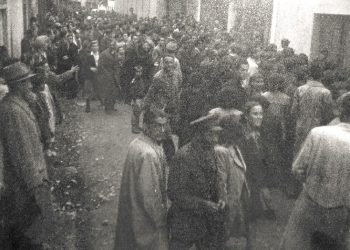
The last three days, March 16, 17, 18, in the Church of Our Lady of the Rosary, the Eucharistic Host was taken out, for adoration only by the priests, who were numerous. The last day, when the final church in the city, that of the Rosary, was to be closed, horrified the city. It was a Saturday. In the office of the Front, before a commission, all the clerics were summoned one by one. The priests were required to renounce their priestly office. The priests were all at the head of their duty. Even one, who had served the Front, and consequently the government and agencies, told them: “We are not with you here.” Dom Kolec Toni and I were not summoned, because officially it was not known that we were priests. In this extremely beautiful and deeply painful afternoon, the keys to the church were taken. A taxi was taken for the Monsignor and he was accompanied by Father David Piçi, Dom Kolec Toni, and I. They took him to his sister’s house, Gjyliana’s. On the road, there was a great crowd, which did not allow the car to pass quickly, and which was wisely driven by a Muslim.
The tearful eyes of the people, in those historical moments, sought his holy blessing. In the Convent, the Franciscan Father Ciril Cani, 90 years old, had remained. Unaware of what was happening, he cried like a child, asking where his friar brothers were. They took him to a family. This was March 18th, which gave us the next day, the unforgettable March 19, 1967, in history and in centuries, the Day of Saint Joseph, Patron of the Church. A day without hearing a single bell ring, and without seeing an open church door. It was also Palm Sunday. Calamity and mystery, with strong events on earth.
Closure of Churches and Parishes (March – September 1967)
Churches were closed in villages and highlands, in the same style and manner, and everywhere with the force of the party that reigned supreme, the fury of the Front Organization, and the terror of the State Security. Some members of the Youth organization, called revolutionaries, and such people, taught all their lives in deceit, were used; they spread words against the clergy, saying that: “You have lived enough at the expense of the people, and with your lies.” The terrorized people lived with pain and tears. The parishes were closed within 23 weeks. From the parish of Beltojë and Asht, they took and quickly removed the parish priest, the educated elder, Dom Nikollë Shllaku. He returned to his home in Shkodra and fell gravely ill, died quickly, and was buried in the Rëmajt cemeteries in Shkodra.
Bushat had as its priest Dom Zef Gila, who had completed his studies at Propaganda Fide in Rome. The fury of closing churches in the Bushat Deanery was very rapid. Dom Mikel Beltoja, the zealous, brave, and energetic Prelate of Barbullush, would a little later tell the “People’s Power” who closed the churches. “Not the people, the force of the party.” Dom Mikeli would dedicate himself to religious services in many parishes until, after some years, through his good works, secret and not secret, he would be arrested and executed, to be a Hero and martyr, the lion of the Catholic villages. The village of Juban had as its parish priest the distinguished priest in all virtues, Dom Injac Gjoka. The day the Church was closed; few people had closed their eyes that night. But Dom Injaci would be found by the villagers of the parish and of other parishes in Shkodra, in a room like a prison, to perform as many religious services as possible. Dom Injaci could not morally refuse to serve, and would never want to abandon the faithful until death, which occurred on November 12, 1979.
Dom Marin Shkurti and Dom Prenk Nikçi
The parish of Stajka with the young and hardworking priest for the faith, Dom Marin Shkurti, showed vitality. This parish, in a letter that reached the Bishop of Shkodra, Monsignor Ernest Çoba, from the Church Council and several other villages, requested that the Church not be closed, and they were ready to defend it at all costs. The Church would be closed because it was a plan, it was a revolution. Dom Marini, after a year of religious service, fled with his entire family to Yugoslavia. He was handed over to Albania and, after severe torture, was executed, and his four brothers were imprisoned along with their wives.
In Velipoja area, Dom Prenk Nikçi, a priest who was a member of the General Presidency of the Democratic Front in Tirana, served tirelessly. When the churches and religious institutions were closed, he was summoned to the Executive Committee of the district, by its chairman, Bilal Parruca, who naturally received him well and demanded from him to appear at a large meeting to denounce religion and its work. He was also asked to renounce the priesthood. Sitting in the armchair, in that office of such secret affairs, Prenka immediately stood up, saying these words, as was his nature: “I have worked much for you, until now, but in these things you are doing, I will not participate. I will not speak against faith, nor deny my duty.”
This testimony was heard in the city, cities, and villages. After a few months, they put him to heavy work, in the lime kiln of Kruja. It is unknown how it happened, but Dom Prenka was found fallen inside the lit furnace. That is how he passed away, in those torments, as a sacrificed priest, and as a saved martyr.
Dom Martin Trushi, the zealous and regular priest of Dajç of Bregu i Bunës, returned home to Shkodra, quickly joining the Brick Enterprise, to perform services, until his arrest in 1974.
… The Thethi area and the Great Highlands were served by Father Robert Ashta, who managed to give the people some explanations on how baptisms and weddings could be done secretly. Father Benedikt Dema of Bajzë came to Shkodra after his church was closed. Monsignor Antonin Fishta (Apostolic Administrator of Pult) died of a heart attack in 1968 after being forced out of his residence. Dom Pjetër Gruda, the beloved priest of Shkrel, was arrested and died in the Saranda prison shortly before the freedom of religion arrived in 1990.
The Bishop of Lezha, Nikollë Troshani, witnessed a savage attack on Easter day, March 26, when the bell tower of the Franciscan Church in Lezha was torn down and churches were razed or turned into stables and military depots./Memorie.al