By Shkëlqim ABAZI
Part forty-seven
S P A Ç
The Grave of the Living
Tirana, 2018
(My memories and those of others)
Memorie.al /Now in my old age, I feel obliged to tell my truth, just as I lived it. To speak of the modest men, who never boasted of their deeds and of others whose mouths the regime sealed, burying them in nameless pits? In no case do I presume to usurp the monopoly on truth or claim the laurels for an event where I was accidentally present, even though I desperately tried to help my friends, who tactfully and kindly deterred me: “Brother, open your eyes… don’t get involved… you only have two months and a little more left!” A worry that clung to me like an amulet, from the morning of May 21, 22, and 23, 1974, and even followed me in the months after, until I was released. Nevertheless, everything I saw and heard during those three days; I would not want to take to the grave.
Continued from the previous issue
XXII
Second time in the hospital!
(When the dead man resurrected!)
The Cathedras of the Holes
The second zone became my home, while the brigade became my extended family. In it struggled a conglomeration of several races, several nationalities, and several faiths; with different origins, different formations, but they were brought together by one “vice”: almost similar political views and a meager predisposition for rehabilitation, according to the viewpoint of the Head of the Technical Office and the Camp Command, of course. They had gathered there whites and Roma, Italians and Greeks, Serbs and Montenegrins, Bosnians and Bulgarians, Aromanians, Greek minorities, Shule (people from the Postec area of the Prespa basin), Goran and Vrakaçorë (Slavic-speaking groups), etc., even American citizens and one Australian, even a horse trader (arixhi), but over ninety percent consisted of ethnic Albanians from various regions.
Regarding social background, there were fundamental differences; starting with scions of aristocrats and sons of great families, it continued with descendants of distinguished patriots, Beys, Aghas, bourgeois, landowners, and was completed by a host of citizens and villagers, rich and poor. The professional aspect, however, was more diverse. You encountered all kinds of professions and trades; from farmers and livestock breeders, workers of all crafts, and intellectuals, up to fathers of the nation, former ministers, former diplomats, former deputies, philosophers and professors, engineers and doctors, artists and musicians, painters and sculptors, writers and poets, journalists and athletes, students, and even academic scientists, and even a horse-dealer.
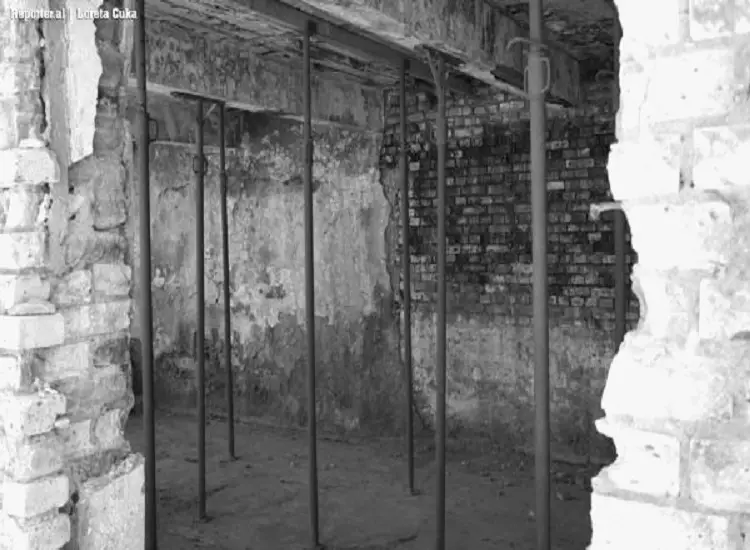
In the mines, they “sheltered” the leaders of religious faiths, Hoxhas and Babas, Catholic and Orthodox priests, down to seminarians, medreses and deacons, turning them into catacombs of modernity. Debates buzzed in the galleys, as in auditoriums. On the stone ceilings, philosophy and enlightened thoughts were plastered, if digital equipment had existed back then, today we would have the chance to follow topics and reports that far surpass those of today, presented by brave intellectuals, whom even modern philosophers would envy, indeed their erudition would be coveted by every university cathedra, it would elevate every parliamentary hall, and would be the honor of every academy of sciences.
In the electrified atmosphere of the caverns, I found myself like a fish in water. Among the prominent personalities, I heard in vivo what I learned from books and digested it more easily. The work front was quite far away, and the path exhausted you. During the rains, a reddish sludge formed on the ground trodden by thousands of feet, in which the boots splashed, God forbid, while the frosts turned the footpaths into ski slopes, where you could slide down the embankment and end up with serious trauma. Therefore, under the soles of our boots, we fastened some clogs with metal spikes, we gripped them with straps to the lower part of the neck (bootleg) and strung ourselves along like horses shod with horseshoes, on the uphill of the Calvary. This practical innovation by Milto Feshti and Fiqiri Muha, as hindering as it was useful, cost two or three packets of “Partizani” cigarettes and became an indispensable part of the seasonal equipment.
As soon as you entered the mouth of the gallery, you escaped the toils, although you had to push through eight tiring hours. The temperature in the belly of the mountain somewhat compensated for the fire that the communists deprived us of, but which Hadi (perhaps a sardonic reference to ‘Hell’ or another person) “gifted” us in abundance. Besides this, we enjoyed another privilege. After throwing off the hindering clogs and the snow from the tarpaulins, we felt free, lit the lamps and plunged into the paths of hell, with the feeling of the master of the house who knows every corner and niche and finds every entrance, every exit, every corner, every angle blindly, because we were in our environment, among people who understood each other.
Since it fell to our lot to be in the most undesirable grip of Spaç, we debated without the feeling of being overheard, because we were far from the eyes and ears of the police and spies, who rarely set foot in those holes. Except for the brigadiers, the free and the prisoner, who came twice per shift for inspection, adding the blasters who set off the explosion for the next shift, and on specific occasions, even a policeman, no one else was seen. Naturally, the “negligence” did not imply concessions; on the contrary, they demanded the norm fiercely! The brigadiers and blasters were the eye and ear that kept the command informed about what was happening underground. When the cycle was not met, a flurry of police would rush down the shaft, and the cudgel would crackle, and the irons would clang, oh my God; they vented their frustration for the contaminated relief onto our backs.
Everyone hated that area, the police more than anyone because they were terrified of the permanent danger of the sandy-lime formations, destroyed by erosion and continuous blasting. The sudden collapses from the shattered ceilings, which continuously dripped acid rain and soaked into the flesh, turning clothes into scarecrow rags, as well as the irreparable consequences it left on the eyes and skin. Another reason to avoid it was the filth. You went in clean and came out scabbed, like grease cleaner after cleaning grease or burnt oil. Who would covet this kind of toilet, which if a cow licked it, it would die instantly? No one! The police less than anyone, because the shine of their Chinese-style uniforms, with which they strutted like roosters on a dung heap, was lost. The pyrite holes blackened everyone. When you came out black from head to toe, you felt disgusted with yourself.
Even after months, I couldn’t get used to the slag and the acid stench; in fact, my revulsion grew day by day. When I left the gallery, I closed my eyes so as not to see my comrades who were blackened like coal, because I imagined myself in that state too. So, I pressed the spongy nose-plug to my face, so as not to inhale the stench of my clothes, and I held out my hand at a distance to my fellow sufferers, to whom we handed over the shift. Blackened like that, we mocked each other: “Ooh, what a handsome man!” – said one. “You’ve put on the mask of Lucifer!” – said the other.
“Are you trying out for the role of Othello?” – the doctor-writer teased me one day. “I refuse to answer, honored sir, because you represent the ‘synthesis of the system’!” – I retorted with a laugh. Modesty aside, the “synthesis of the system” was my authorship, which others also adopted. With this syllogism, I baptized my colleagues from the pyrite galleries. Naturally, without excluding myself, I directed the jab at Doctor Astrit Delvina, who ridiculed and labeled us: “Regime currency,” meaning they used us as a unit of exchange in negotiations for the buying and selling of persons. And he illustrated it like this:
“As soon as they notice signs of stubbornness in someone, or plainly, the head of the Technical Office, the free brigadier, or the convict, a spy or a policeman who suspects that X does not show signs of rehabilitation, or because he is intransigent in his anti-communism, the exchange negotiations begin: ‘Give me this gentle one, I’ll give you this harsh one!’ or: ‘I’ll give you this Ballist, give me two revisionists!’” and the exchange was done by heads, as in the livestock market, even with a premium (hyst – bargaining chip/premium)!
Then he concretized the theory with facts: “Look, let’s take Mr. Esat as an example, whose presence graces our ranks, meaning he is effective in our brigade. But to realize this transaction, a long bargaining was needed, with a quite salty price. Two fairly weighty heads were put into play, a socialist-revisionist of international scale, like Comrade Skënder Thaçi, and Mr. Esat’s older brother, the Ballist Bejo. Thank goodness, an agreement was reached; today we have his grace, Mr. Esat, in our midst!” – Astriti mocked. But Esati did not lag behind either, he returned in kind: “Honored Wri-ter, they move me everywhere in the orbit of the burgograd (prison-city), like a free electron, but you, they freeze and melt you in the same zone, you unfortunate one!”
“Precisely therein lays the difference, my dear, because I represent the nucleus that attracts the electrons!” – the doctor retaliated. – “Why else would we have nicknamed you ‘synthesis of the system’?” – and the jokes continued. Although these jokes were made in our spaces, the humor went beyond the circle and reached the command, word of mouth and ear to ear, until they became a bone of contention and cost the writer a week in the isolation cell. “Why haven’t you fulfilled the plan?” – Shahin Skura found a pretext. “We did the impossible to meet the norm, but…!” “What is this ‘but’?” – the furious Commissioner interrupted. – “I wanted to tell you that the mining accidents are unpredictable…!” – “I am not interested in the accidents, convict, I want the plan!” – “Obstacles arose, sir! A collapse here, another one further away, then the pipes are corroded by the acid and burst, the nails and rails slip off the tracks, and time ran out…” – the writer tried to defend himself.
“Scribbler justifications! Is time wasted on chatter?! Or have you gathered a bunch of saboteurs who want to mock the plans of the Party and Comrade Enver, just to blacken our reputation! But we won’t allow you, either the plan or your soul, your spirit will leave you right here!” – Shahini bellowed, trying to intimidate the others besides Astrit.
“Sir, according to the assessment of the glorious theoretician, Comrade Stalin, ‘Man remains the most precious capital’! We strive to realize this message, with human values,” – the doctor ironized.
“You, the enemy, dare to cite Comrade Stalin?!” – “I mentioned the quote that you have written in capital letters on the face of the rock!”
Indeed, one could read the slogan above the galleries of the first zone, like a bitter irony.
“We wrote it for the purpose of rehabilitation,” – the Commissioner interrupted, exasperated.
“I can’t imagine how you can separate human destinies! As far as I know, every life is equivalent to the others, and it is a universal right…” – “What the Party and Comrade Enver should do, let me show you the universal right! You Ballists, do not deserve any right!” Perhaps he felt awkward because they had written down on paper what they never implemented? “I don’t understand, what rights are you talking about?” – My friend, worn out by eight hours of exhaustion, retorted.
“About the freedom that you enjoy fully!” – the Commissioner strutted. – “Where is this wretched thing hidden, I’ve been digging for years and haven’t encountered it anywhere?” – Astriti ironized.
“Here, among you!” – he attempted to imitate the “National Hero” in the unique historical context and added viciously: – “Malice and hatred for the people’s power have blinded you so much that you have no eyes to see!” – “Naturally, in the holes where you have confined me, I cannot see the prosperity that you offer us, but I encounter the antithesis every day: terror, violence, misery, suffering, prison, sentences, executions, and persecutions. If you are referring to this kind of freedom, we enjoy it immensely, even in excess!” – the writer continued the irony.
“With capitalist-revisionist glasses, that’s the color you see! Why don’t you ask the people how happy they feel?” – “I don’t know whom you consider the people, but the part I have known does not feel happy at all, let alone free. They struggle for a morsel and keep silent and applaud injustices, under the terror of the prison bogeyman with which you threaten them,” – Astriti debated. “Naturally, as a sworn enemy, you will only know such people, but the people enjoy the freedom and democracy that the Party and Comrade Enver guarantee!” – “Perhaps by freedom and democracy, you mean the field with ideological thorns, surrounded by barbed wire, where you force the people to walk while singing, and they also enjoy the right to stroll with a rope around their neck, within the circle you have demarcated for them! With what beautiful freedom do you exchange the toils of the people?!” – the writer concluded.
“Seven days in the isolation cell, incorrigible enemy!” – the Commissioner delivered his verdict.
After a week, he came out haggard and pale. We met at the entrance of the gallery. I wished him well and asked him: “How did you pass the week, Astrit?” – “Beautifully, my boy!” – “You reflected, I hope?” – “Oh-ho, seven days were enough for me to reflect and benefit from the government’s indulgence!” “And in the end?” – “You want the conclusion?!” – he pretended to be surprised. – “What conclusion did you draw from the isolation cell?” – “Aha! Just like at the beginning!” He made a pirouette, as if drawing a circle with a central point, and repeated: “Just like at the beginning!” – “Specifically?” – “Specifically?” – we knew the repetition was his habit. When he intended to convince others, he first tried to calm his own thoughts.
“Stop fussing, honored doctor!” – the others started the banter. He cast a look as if defying the week he had spent isolated and sighed: “I will speak! Undoubtedly, the word was born first, as a free man, I will exploit the advantage that God granted me! But my freedom is radically different from the Commissioner’s; mine is boundless, without limits, air, water, light, sky, earth, originating from the Almighty God, while his is the isolation cell, prison, violence, gagging, deafness, anguish, anxiety, nightmare, darkness, fence, pivot, order, and directives emanating from the One Dictator.”
“What are you telling us, Wri-ter?!” – Esat Kala prompted him. – “I am trying to explain myself more clearly. My dear friends, freedom is a medal with two faces, on one is engraved the emblem of a bird with open wings, on the other is the blind man with a scale. The bird signifies freedom, the blind man signifies responsibility.” – “Forget the metaphors, tell us the function!” – Esati again. “I will get there, your Grace! Freedom and the blind man are like Siamese twins, condemned to travel and feed on the same blood, the death of one leads to the elimination of the other, and each one of them is responsible for the life of the other, just like freedom without responsibility produces anarchy, and also responsibility without freedom leads to dictatorship.”
“Sophistry, my dear?!” – Esati mocked. – “The democratic world has entwined freedom with responsibility, as a counterweight to civil rights and a condition sine qua non, so as not to abuse it!” – the writer clarified without paying him attention. He ran his hand, covered in pyrite slag, over his pale forehead and restarted: “Only in a democracy does the individual enjoy this right, just as they enjoy the right to life, expression, belief, movement, education, choice of profession, residence, and above all, the right to property and the free, secret vote. They have the inalienable privilege to periodically choose those they believe will fulfill their aspirations, will raise the level of their personal, family, social, and state well-being; in a word, will maximally guarantee their freedom.”
“Oh Writer, we know these things, otherwise we would be beyond the fence!” – Esati interrupted him with a sneer. – “Precisely now we are entering the topic again!” – he became excited and continued: “Your Grace, freedom cannot be without boundaries either, where mine ends, yours begins, where another’s begins, yours and the other’s ends, because anarchy results if the limits are confused, therefore legal acts are drafted to anticipate public anomalies, so that everyone knows their constitutional rights and obligations and applies them in practice.”
“Tell us about the other face!” – I intervened to ease him because he was getting tired with long explanations. – “As for the other side, it is easy to explain but extremely complicated to implement. Generally, autocratic, theocratic, monarchic regimes practice this kind of freedom. But this stands out especially in the communist regime, where everything is tied to the will of the One, who has replaced the autocrat, the theocrat, the monarch, the parties, and God! Usually, these pseudo-regimes come to power with violent revolutions, rely on popular ego, supposedly protecting civil interests, but have a predisposition to turn into dictatorships, because the One attributes boundless power to himself.
Power becomes sweet to him and he perpetuates himself in the chair, equating himself with God, granting himself the right to make the sun and the rain. Meanwhile, he engages in demagoguery about the right to life, but he doesn’t wait for God to take it, he takes it through the courts that act in his name; he thunders about freedom, but he cuts your tongue when you don’t babble what He likes, otherwise, you end up in the court acting in His name; he roars about the freedom of belief, but with one tiny trick, you must offer your adoration of God to the Party and believe in the One, without hesitation, otherwise, the court acting in His name cuts you off.
Naturally, the freedom of movement has been solved by law, normally everyone should enjoy it, without exception and without limit, citizens, villagers, collective farmers, workers, but with one condition: to move as far as the rope that the One has tied around their throat allows, within the perimeter of the field He has marked for them, and whoever attempts to break it ends up as above; while the freedom of education, which determines the future of every aspirant, remains the exclusive prerogative of the One; He thinks about the future, don’t trouble your mind at all, my dear!”
“The freedom to choose residence is inseparable from the previous one, if you have shown sufficient devotion towards the One, you can settle in Tirana, even if you are from the most remote village, otherwise, become the guardian of your ancestors’ bones and dig your grave while still alive, because the pit awaits you, even if you are a prophet! We come to the right to vote, as the fundamental right above all the rights of responsible adults. Every person over eighteen years old enjoys the right to elect and be elected, but only on paper, because in reality, you must vote compulsorily and openly for the one whom the One appoints!”
“I don’t know why you doubt the Almighty, dear writer, He knows whom to choose, because He stays up all night, turning gray for your good and the good of others!” – the baker-painter intervened. – “Down with the enemies who say otherwise!” – Esati also mocked.
“Thus, you are left to get up in the morning, dance a pogonishte (a folk dance) at the voting center with the Roma, cast your ballot into the Democratic Front box, and push your effort into voluntary work, happy that you chose the best one!” – the writer continued, ignoring the interruptions. – “Otherwise, do you know what awaits you? The courts that act in the name of the One and dispatch you to the boondocks!”
“Here with us!” – the painter completed. – “Undoubtedly!” – the writer conceded. – “So, in words, totalitarian regimes impose responsibilities on individuals that they cannot bear, without sanctioning freedom. But the burden of responsibility, on irresponsible shoulders, twists the backs, and consequently the country slides into dictatorship,” – he concluded his pathetic lecture.
That day the writer was more inspired than ever. This usually happened whenever they released him from a prolonged isolation; he would not stop talking for hours, as if he sought to compensate for the loneliness of the cell, where he had meditated extensively, and could barely wait to empty the cells of his productive brain, to make way for new ideas.
“I have a proposal, Doctor!” – I intervened. – “I’m listening, my dear!” – “How about we make a pact? But first, I ask for your understanding, in case of disapproval, I propose we put it to a vote…” – “Speak up, what are you getting at?” – he spoke impatiently. – “We are democrats, aren’t we?” – I asked suggestively. – “Undoubtedly, but get to the point, you poor thing!” – “Nothing extraordinary, when you are late in committing a ‘fault’ that deserves punishment, we fabricate one for you so you can spend at least a week in the cell.”
“What a beautiful pact you wished upon me! How can you supply us with such productive ideas?” – I ended the joke, but the laughter echoed on the stone ceilings, traveled through the shafts and tunnels and erupted on the surface. – “I don’t have the guts to endure these trials month after month, my friend!” – he replied with a laugh. Even without my joke, the sanguine doctor would be confined to the cell from time to time, and the custom would repeat itself. Memorie.al