By Darling Ismail Vlora
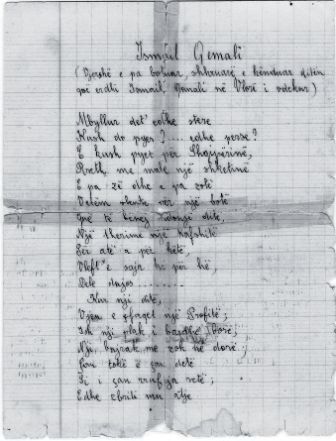
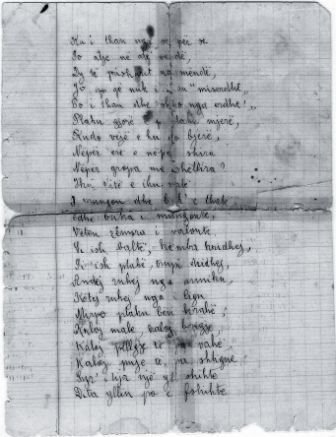
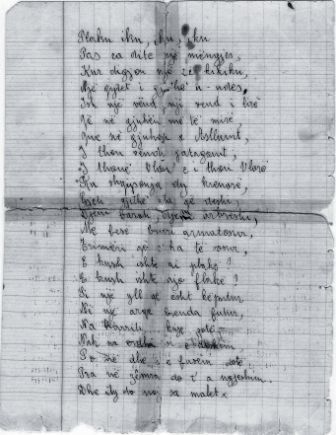
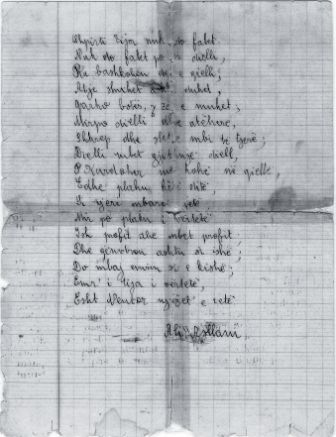
Memorie.al / The four-page manuscript is revealed, which the poet from Vlora, Ali Asllani, wrote on the day the remains of the Elder of Vlora arrived in Vlora, and then were sent to Kaninë. The poet was the mayor of Vlora at the time. In his notes on the funeral ceremony and the memories of that day, he also tells about this poem. Moved by this loss, he wrote the 13 stanzas of the verse and read it at the moment of farewell. He then gifted the manuscript to the sons of Ismail Qemali. The poem is published for the first time.
The Death of the Elder of Vlora
Ismail Qemali died on January 24, 1919, in the Hotel “Brufani” in Perugia, where he was invited by the Italian Government, with the aim of reaching “an agreement with all Albanians of Albania and the American delegates,” to participate in the Peace Conference to be held in Paris. On February 8, 1919, according to his last will, the lifeless body of Ismail Qemali, accompanied by his three sons: Et’hem, Qazim, and Qamil, as well as representatives of the Italian Ministry of Foreign Affairs, was sent by train to Brindisi from where, on board the torpedo boat “Alpino,” it was escorted to Vlora.
THE FUNERAL AND THE DAY OF FAREWELL
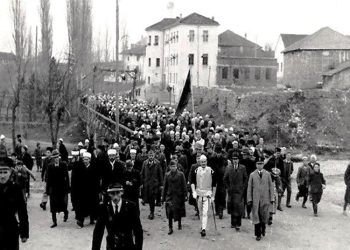
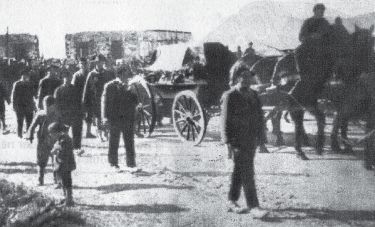
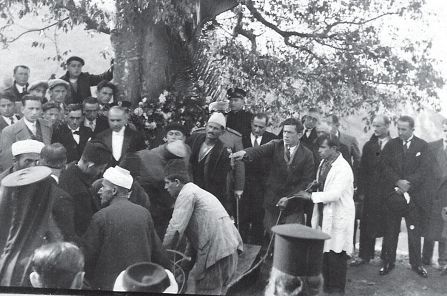
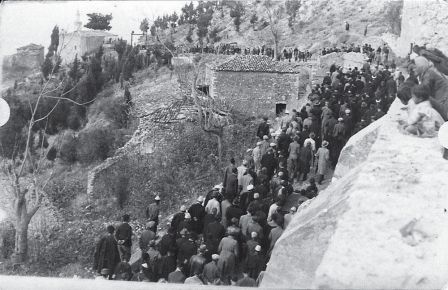
On February 12, a magnificent funeral ceremony took place. The entire population of Vlora had gathered at the Skelet (Port). At 10 AM, the lifeless body of Ismail Qemali, from the building of the “Base Navale” Command, was placed on the cannon carriage. From there, the large cortege set off towards the city. Also present at the funeral ceremony was the Mayor of Vlora, the patriot and poet Ali Asllani. Precisely on this day, as he himself notes, he wrote the poem “Ismail Qemali,” which he gifted in manuscript to his sons.
Also, in addition to this poem, Ali Asllani wrote “The Funeral of Ismail Qemali,” in which the poet expresses the extremely tense situation created in Vlora due to the Italian occupation. The Italian military command had taken all measures so that the funeral ceremony would not turn into a popular demonstration against the occupier. For this purpose, they did not want to allow the use of the Albanian flag in any way, which the poet from Vlora strongly expresses in his verses.
It was January 24, 1919. In Hotel “Brufani” in Perugia (Italy), where he was invited by the Italian Government, with the aim of reaching “an agreement with all Albanians of Albania and the American delegates,” to participate in the Peace Conference to be held in Paris, Ismail Qemal Vlora, the protagonist of Independence and the head of the first Albanian Government, died.
His sudden death, at one of the most delicate moments Albania was going through, on the eve of the Conference’s work, was met with great sorrow, both in Albania and throughout the diaspora. Everywhere, from south to north, to mourn the great loss of their son, the people would weave monumental verses:
“…The sad news came for Vlora
The olive trees lowered their crowns
Albania let go of the song
Because a wound opened in its heart.
Shushica stopped its run,
They say ‘Smail Qemali died.
The flag was covered in mourning,
It weeps for its master.”
On February 8, 1919, according to his last will, the lifeless body of Ismail Qemali, accompanied by his three sons: Et’hem, Qazim, and Qamil, and by representatives of the Italian Ministry of Foreign Affairs, was sent by train to Brindisi from where, on board the torpedo boat “Alpino,” it was escorted to Vlora.
On February 12, a magnificent funeral ceremony took place. The entire population of Vlora had gathered at the Skelet (Port). At 10 AM, the lifeless body of Ismail Qemali, from the building of the “Base Navale” Command, was placed on the cannon carriage. From there, the large cortege set off towards the city. “The city rested that day. A great silence reigned everywhere. It seemed like a somber day: the closed shops of the market showed it, the death notices posted on shop doors and walls showed it, the papers with a black border and the words: ‘National Mourning for the great patriot Ismail Qemal,’ all the frowning faces of the people showed it.
Women and girls had come out on the doors and windows of the houses, and all mentioned the name of Ismail Bey, all remembered the Elder of Albania. Yes, all remembered him with reverence because some of them had even known him: they knew the time of childhood he had spent in this city, they had seen his generous face, they had heard of his holy deeds, and they had also participated in the great joy of the blessed day of November 28, 1912, that historical day that gave the Albanian Nation its independence and saved it from the greedy claws of neighboring enemies.
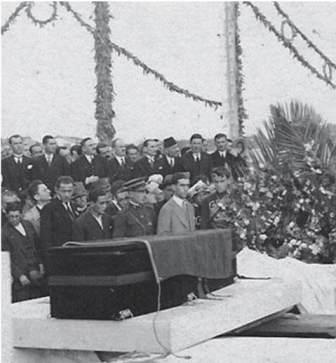
In front of the large market, the procession and the body of the deceased stopped, where two moving and sorrowful speeches were held, one by Prof. Jani Minga and the other by Mr. Qazim Kokoshi, and where the final salute was made by the army with the royal march and with soldiers holding their arms in honor.
After this ceremony, the coffin was taken to Kaninë, accompanied by the troop of Cavalry soldiers, by the religious leaders, by the high officials, and by a large part of the population of Vlora. In Kaninë, the usual prayers were said and then the holy body of the deceased Elder was buried next to the grave of Ferid Pasha, to make the eternal rest in endless life, leaving his name, memory, and deeds immortal and everlasting in the heart of the Albanian and in the history of the revival…”.
Also present at this funeral ceremony was the Mayor of Vlora, the great patriot and poet from Vlora, Ali Asllani. Precisely on this day, as he himself notes, he wrote the poem “Ismail Qemali,” which he gifted in manuscript to his sons. Also, in addition to this poem, Ali Asllani wrote “The Funeral of Ismail Qemali,” in which the poet expresses the extremely tense situation created in Vlora due to the Italian occupation. The Italian military command had taken all measures so that the funeral ceremony would not turn into a popular demonstration against the occupier. For this purpose, they did not want to allow the use of the Albanian flag in any way, which the poet from Vlora strongly expresses in his verses:
“…When above the ark where the Elder lay
The color of a flag appeared…
It was the flag of Italy!
The voice of the youth thundered!
It seemed the Elder himself
Asked us something through the silence,
As he asked before
‘Where is the flag that I hung’?”
Thanks to the protests of the people of Vlora, and at the same time to avoid the consequences that such an attitude would bring, the Italian command allowed the coffin, where the body of Ismail Qemali rested, to be covered with the Albanian flag:
“…Vlora did as it wished,
Dressed him with its flag,
Dressed the Elder with the flag
With the blood-colored flag!
With a black eagle in the middle,
And the deceased who does not die
Took the road to Vlora…”.
Ali Asllani’s admiration and respect for the Hero of Independence are clearly evident, not only in the verses he wrote for him but also in the few memoirs he managed to publish on Independence anniversaries. In the verses of the poem “Ismail Qemali,” in these few lines, the great poet, with the power of his pen, describes the entire history of the Elder of Vlora, or the “Immortal Elder,” as he called him; his life; the difficulties he encountered in the Proclamation of Independence; the role he played in it; his patriotism; sacrifices; the love the people had for him; and even the harm his sudden death brought to the nation, concluding with the verses that completely synthesize the life and work of Ismail Qemali:
“…The true Elder was a Prophet
and remained a Prophet
And he stands as he was;
He will keep the name he had;
His true name
is November twenty-eight…!”
THE FOUR PAGES OF YELLOWED MANUSCRIPTS
Ali Asllani was born in Vajzë, Vlora, on November 20, 1882. His parents, Asllan and Hyjrie, died young, leaving him still small. After finishing elementary school, in “Muradie” of Vlora, he settled in Ioannina, where he studied at the well-known “Zosimea” school. He completed his higher education in Istanbul, where after attending Medicine for one year, he enrolled in the High Institute of Political-Social-Administrative Sciences, which he finished in 1906.
Ali Asllani was active in the national patriotic movement from a young age, being one of the prominent members of the “Bashkimi” Club of Ioannina. Due to his cooperation with Ismail Qemali, he began to be persecuted by the Turkish government organs, and an order was even issued for his internment. He managed to escape internment by moving to Corfu and from there to Vlora. He participated in the Congress of Dibra (1909), as a representative of the “Bashkimi” Club.
In 1910, after the fall of the cabinet that had interned him, he returned to Istanbul. After the Proclamation of Independence, Ismail Qemali entrusted him with the duty of Secretary General of the Presidency and the Council of Ministers, a duty he held until January 22, 1914, the day Ismail Qemali resigned from the Vlora Government. Even after Ismail Qemali’s departure from Albania, he maintained contact and regular correspondence with him, along with other patriots from Vlora, such as Ibrahim Abdullahu, Hasan Sharra, Abaz Mezini, Alem Mehmeti, Osman Haxhiu, Qazim Kokoshi, etc.
The Italian occupation found him as sub-prefect, but since he opposed the occupation, he was dismissed from work. From December 1918 until November 1920, he was the Mayor of Vlora. In the years 1921-1922, he was the Chief Counselor of the Government and then the Secretary General of the Prime Ministry. For a long time, he was appointed Consul in Trieste, where he remained until the end of April 1925. That same year, he was appointed ‘Deputy Chargé d’Affaires’ in Sofia, later, there; he was appointed ‘First Secretary’ and ‘Chargé d’Affaires’.
In the years 1930-1932, he was an accredited Minister to the Greek state. In 1934, he was again the Mayor of Vlora, until the eve of the fascist occupation, in 1939. After the occupation, he was appointed a member of the High Council but, very soon after this appointment, he withdrew from political life and settled in his hometown. After the “liberation,” he was one of the founders of the League of Writers and Artists.
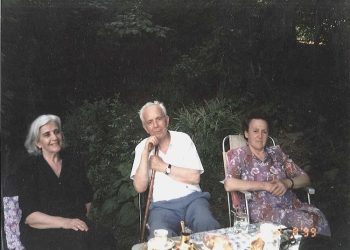
Although he was not punished, as happened to many of his friends and family members, the life of the great poet and patriot, after the “liberation” of the country, was very difficult. He maintained his friendship with Ismail Qemali’s family throughout his life. Already in Istanbul, he had befriended all his sons, especially Qamil Vlora, who died in communist prisons in 1950, at the age of 55. Esma Vlora (Hurshiti), the wife of Qamil Vlora’s son, Ismail, remembers “the elder” Ali Asllani with great respect.
“Whenever he met us,” she recalls, “since we were still young, he would address us, to give us courage, with the phrase ‘Amore felicità’ (Love, happiness). Ali Asllani, in addition to his friendship with Ismail Qemali, had been friends with his sons and especially with Qamil Vlora, and for this, he was very sorry that my husband, the son of Ismail Qemali’s son, and his family suffered in Albania even for a piece of bread…”!
Certainly, for Ali Asllani, whom “tears streamed… whenever he remembered Vlora and its distinguished men like Ismail Qemali, Ibrahim Abdullahu, Osman Haxhiu, Qazim Kokoshi, Hamza Isai, Abaz Mezini, Jani Minga, Tol Arapi, Halim Xhelo, Abdul Kuçi, Ahmet Lepenica…”, it was heavy to see not only his family but also many other patriots, who had fought with him, who had given everything for the nation, persecuted and their families suffering for food. Therefore, from his soul “which inwardly had the waves of a great pain,” the verses would strongly emanate:
“Give your hand, give your hand
To this boy whose father,
Gave us all that he had,
Gave us life, gave us Vlora!”
A few years before his death, (finally) a small pension was allocated to him! He died in Tirana on December 20, 1966.
The Creative Work of Ali Asllani
Ali Asllani’s creative work began at a young age, during the period he was studying in Ioannina. He continued to write in Istanbul where his verses can be found in various periodicals such as: “Dituria,” “Përfytyrimi i shkencës dhe edukatës,” etc. Among the first verses he composed were “My Village” and “The Spring.” During the years 1914-1920, he wrote many poems, but most of them remained unpublished.
In 1920, he wrote “Vlora-Vlora,” which was born in the fire of the Vlora War and turned into a song-anthem, accompanied by the music of the master Thoma Nasi. During the 1930s, he published many poems in the press of the time, but the one that made him known and ultimately brought the poet into Albanian literature is his major work, the poem “Hanko Halla.” Written in 1929 in Sofia, this poem was published in parts, initially in “Kosova” of Constanța (1932) and later in “Shkëndija” (1942).
Also in 1942, the poet published it in full in a special edition, along with the long verses “Albanian Wedding” and “Albanian Girl.” Before his death, he managed to publish a few books: “Vidi-vidi pëllumbeshë” (1960), “Shqipëria kryesorja” (1961), “Vajzat dhe dallëndyshet” (1964), “When the lightning catches fire” (1966).
After his death, “Albanian Poetry” (1973), “Selected Poems” (1996), and “Vidi, vidi pëllumbeshë” (1999), etc., were published. In addition to his political-patriotic activity and literary creativity, Ali Asllani will remain known for the city of Vlora for the construction of two monuments: the “Pillar of the National Flag” in Flag Square, and the “Clock Tower,” both sketch-ideas were prepared by him and their inaugurations took place in 1937, during the period when he himself was the Mayor of the city.
ISMAIL QEMALI
(Unpublished verse, written and sung on the day Ismail Qemali arrived dead in Vlora)
“Closed sea and land
Who will ask?…and why?
And who asks for Albania,
Surrounded by mountains, a wasteland
Voiceless and masterless
It was only worth for a world
That it would become one day,
A crumb, a bite
For this one and for that one,
Its worth for now,
Sheep for the uncle……..
When one day,
A Prophet comes and appears;
He was an Elder as white as snow,
A flag with a bird in his hand;
He tears through land and tears through sea
As lightning tears through the clouds;
And he descended right there
Where they call him for no reason
Right there in that place,
The two corrupted ones in mind,
Not only did they not say “welcome”
But they said “go back where you came from!”
Poor Elder, miserable Elder,
Where will he go and where will he fall,
Through wind and through rain
Through pits with brine?
Day passed and night passed
He is missing even dry bread;
Even bread was missing for him,
Only his heart boiled.
Since it was mud, his foot sank,
Since he was old, his body trembled,
He was guarded from the enemy there,
He was guarded from the evil one here.
But the Elder grew wings;
He crossed mountains, he crossed shores,
He crossed pathless ponds,
He crossed trackless forests
His eye saw a star
The day was hiding the star.
The Elder left, left, left
A few days later one morning,
When a sound ‘kikiku’ is heard,
A whole city was ignited.
It was a place, a free place
That in the best language
That in the language of Asllani,
Is called the land of the scimitar;
It is called Vlon’ and it is called Vlora
Where the two-headed Eagle,
Found all those he wished for,
Sons of gunpowder, sons of Arbëresh,
Armed with a man’s faith,
Bravery that has no end,
And who was that Elder?
And who was that flame?
Like a star that has been cut off
Put inside an ark,
He hit us…. Woe today
He did not come as we wished,
But if we cannot put him in the ground
Then we will press him into our hearts.
And there he will live as long as the mountains
His soul will not be forgiven
It will not be forgiven but like the Sun,
Where the sea and the sky meet,
He fades there, as it should be,
The world murmurs and is silent;
But the sun even then,
Flashes and shines upon others;
The Sun remains always the Sun,
Always with its head in the sky,
And the Elder this day,
Finished life as a man
But the true Elder
Was a Prophet and remained a Prophet;
And he stands as he was;
He will keep the name he had;
His true name;
is November twenty-eight.”
THE POEM
In the verses of the poem “Ismail Qemali,” the great poet, with the power of his pen, describes the entire history of the Elder of Vlora, or the “Immortal Elder,” as he called him; his life; the difficulties he encountered in the Proclamation of Independence; the role he played in it; his patriotism; sacrifices; the love the people had for him; and even the harm his sudden death brought to the nation, concluding with the verses that completely synthesize the life and work of Ismail Qemali. / Memorie.al