• Rreth Nesh
  • Kontakt
  • Albanian
  • English
Thursday, January 22, 2026
Memorie.al
No Result
View All Result
  • Home
  • Dossier
  • Interview
  • Personage
  • Documentary
  • Photo Gallery
  • Art & Culture
  • Sport
  • Historical calendar
  • Others
  • Home
  • Dossier
  • Interview
  • Personage
  • Documentary
  • Photo Gallery
  • Art & Culture
  • Sport
  • Historical calendar
  • Others
No Result
View All Result
Memorie.al
No Result
View All Result
Home Dossier

“This unification of alphabets, this separation from a Byzantine issue that has disgraced us until today, is the fruit (or ‘the tree’)…”/ The writing of Mid’hat Abdyl Frashëri about the Congress of Manastir, November 22, 1908

Kontributi i madh diplomatik i Mit’hat Frashërit si ministër fuqiplotë në Athinë, në mbrojtjen e popullsisë çame në Greqi, pas ‘Traktatit të Lozanës’, me shpronësimet dhe shpërnguljet e shqiptarëve në Turqi
“Ky bashkim i abeceve, kjo ndarje nga një çështje bizantine, që na nxinte faqen gjer më sot, është pema …”/ Shkrimi i Mid’hat Abdyl Frashërit për Kongresin e Manastirit, 22 nëntor 1908
“Kongresi i Drejtshkrimit që vendosi toskërishten si gjuhë letrare, ishte rrjedhimi logjik i një politike 30 vjeçare terrori ndaj gegërishtes…”/ Refleksionet e nipit të ish-kryeministrit shqiptar
“Ky bashkim i abeceve, kjo ndarje nga një çështje bizantine, që na nxinte faqen gjer më sot, është pema …”/ Shkrimi i Mid’hat Abdyl Frashërit për Kongresin e Manastirit, 22 nëntor 1908
“Në Liceun e Korçës, botonte poezi dhe përkthente Balzakun e Lamartine, por u diplomua për matematikë në Montpelje…”/ Historia e panjohur e ‘Harry Fultzit’, shqiptar, që drejtoi për 22 vjet ‘Polikumin’ në Tiranë
“Ky bashkim i abeceve, kjo ndarje nga një çështje bizantine, që na nxinte faqen gjer më sot, është pema …”/ Shkrimi i Mid’hat Abdyl Frashërit për Kongresin e Manastirit, 22 nëntor 1908

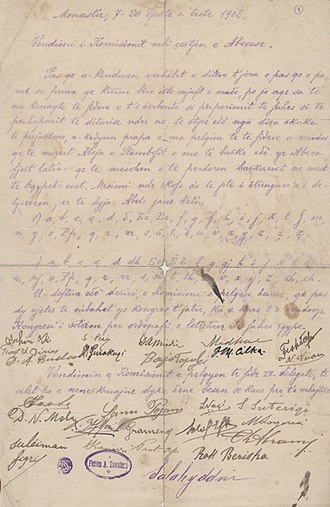
Memorie.al / Three months ago, when it was announced that a congress for the Albanian alphabet would be held in Manastir (Bitola), many people, perhaps the majority of Albanians, said that our nation had not reached the stage necessary to hold such a meeting, for an issue of such importance. And so, the news of a congress was met with some coolness. But look how they were wrong, or rather, how we were wrong, because all that fear turned out for our good and joy.

We can say that the fruits of the congress are many and varied. The first goal of the congress was unification into a single alphabet and the end of the confusion. In the congress, all the delegates thought with great wisdom not about their own desires and biases, but about the good of the nation.

Before the congress was gathered, we feared that every delegate would defend the alphabet used by the society that sent him, and we greatly feared that it would end here without achieving anything. Now all this fear seems to us like a bad dream, a black dream, dispersed by the light of the congress. The congress was very successful, as its fruits pleased us all.

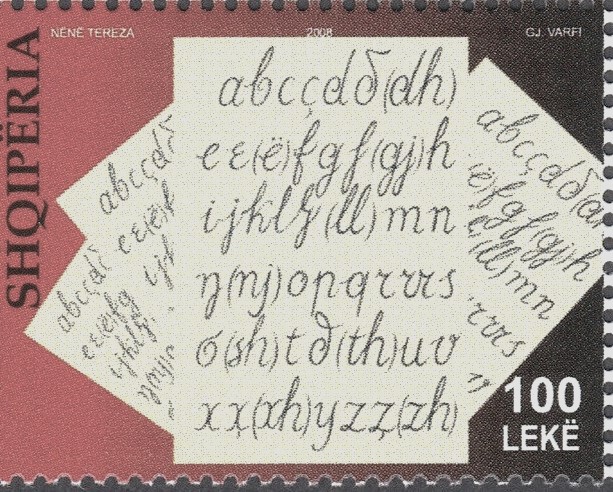
Now, therefore, we say that the writing of our language is settled, we say that the alphabet is unified; now we will gather all our strength to write and advance the language, without wasting time in quarrels and disagreements over alphabets. Now our entire desire will be to bring forth necessary works, to spread education, and to flourish the language, [producing] scholarly, educational, and literary books…!

Gjithashtu mund të lexoni

“According to Dr. Teodor Kareco, a former official of the Labour Party but an objective researcher of the War, the number of partisan and nationalist martyrs is 3,442 people…” / Reflections of the renowned historian on the book by Dr. Uran Butka.

“Anyone who brings about public terror, causes disturbances and disorders, detonates or sets dynamites, explosives, bombs, lethal or incendiary machines, shall be punished…” / What did the Penal Code of 1928 provide for?

This unification of alphabets, this separation from a Byzantine issue that has disgraced us until today, is the first fruit of the congress. But there is another fruit, which is perhaps greater and more beautiful. This fruit is also the unity of the Albanians. Indeed, until today our nation had not united to do a proper job for the country.

Thus, this gathering was a new event for us, where we saw Albanians coming from the north and the south, from the east and the west, where we saw side by side Gegs and Tosks, Christians and Muslims, Hoxhas and priests. Then we understood that a nation truly exists and that this nation is truly alive!

May God grant that this congress be a foundation for eternal unity, like the dawn of a new life, a life of wisdom and brotherhood? Oh, now that we have seen the Albanians together, now our hope is strong, now our hearts are warm.

Now we know that we too are capable of wisdom and unity. A brotherhood was rooted in our minds and hearts; and those roots will always give us new strength.

The meeting of Manastir, just as it revealed our strength to us, also showed the world the existence and vitality of an Albanian nation. The world, which assumed we were incapable of any civil achievement, that world, including our enemies, now understood that the Albanians were not as they supposed that they were not as “savage” as was said.

This congress, this first sign we gave of civilization, added honour before our own eyes and before the eyes of the world. Let us, therefore, always prove capable of maintaining and increasing this honour.

Lumo Skëndo (Mid’hat Abdyl Frashëri)

*Published in the newspaper “Lirija” (Freedom), Thessaloniki 1908

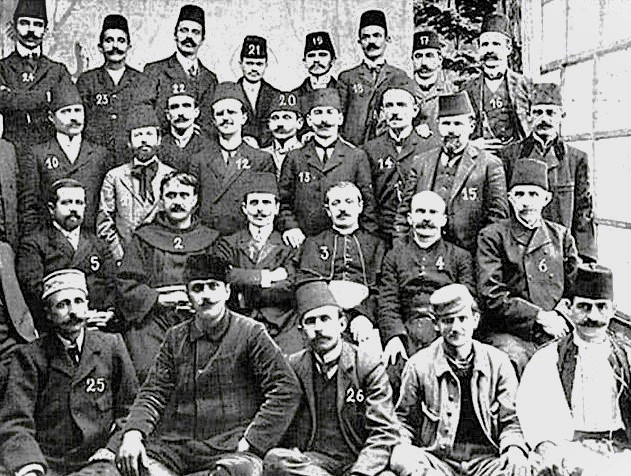
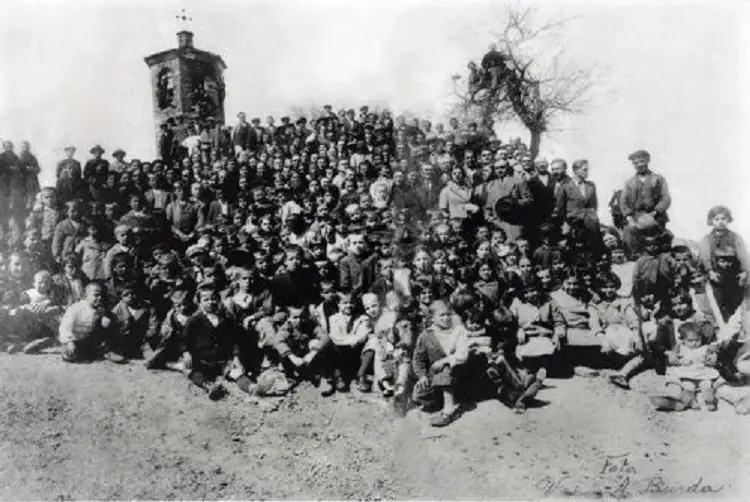
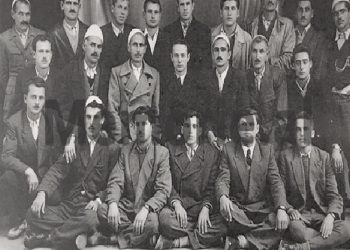
Photo from the magazine “Diturija” (Knowledge) of March 1909

(According to Mid’hat Frashëri’s description on page 41)

In the first photo we see these delegates:

  1. Midhat Frashëri (“Lumo Skëndo”) delegate of the Thessaloniki Club and the Ioannina Club; elected chairman of the Congress; director of our periodical and the newspaper “Lirija” (Freedom).
  2. Gjegj Fishta delegate of the “Bashkimi” (Union) Society in Shkodra; author of The Lute of the Highlands (Lahut’ e Malsisë), The Anzats of Parnassus, and other books and verses; director of an Albanian school in Shkodra.
  3. Emzot Kaçorri, delegate of Durrës and assistant to the Archbishop of that city.
  4. Dom Nre Mjeda, delegate of the “Agim” (Dawn) Society in Shkodra, chairman of this society and author of the school books of this society; poet.
  5. D. Qiriaz Manastiri, delegate of Manastir, vice-chairman of the Congress and author of Hristomathi (Chrestomathy).
  6. Fehim be Zavalani, delegate of Manastir, chairman of the Manastir Club.
  7. Dimitri Mole, delegate of Philippopolis (Plovdiv).
  8. Nyzhet Vrioni, delegate of Berat.
  9. Rok Berisha Gjakova, delegate of Skopje.
  10. Bajo Topulli Gjirokastra, deputy of Gjirokastra, freedom fighter.
  11. Thoma Abrami, delegate of Korça, director of the periodical “Besa” which was published in Cairo.
  12. Sotir Peci Dardha, delegate of the Albanians in America and Bucharest, director of the newspaper “Kombi” (The Nation) in Boston.
  13. Luigji Gurakuqi Shkodra, delegate of this city; author and poet under the pseudonym “Lekë Gruda”.
  14. Shahin Kolonja, delegate of Kolonja; director of the newspaper “Drita” (The Light) which was published in Sofia; deputy of Korça.
  15. Ahil Eftim Korça, delegate of Constanța.
  16. Adam Shkaba Stratobërdha, delegate of Sofia.
  17. Dimitri Buda Elbasani, delegate of this city.
  18. Matea Logoreci Shkodra, delegate of the Agim society of this city.
  19. Aziz, delegate of Starova.
  20. Shevqet Frashëri, delegate of Korça.
  21. Simeon Shuteriqi Elbasani, delegate of this city and secretary of the Elbasan club.
  22. Leonidha Naçi Korça, delegate of Vlora.
  23. Zejnel Glina, delegate of Leskoviq.
  24. Sami Pojani, delegate of Korça, director of the newspaper “Korça”.
  25. Refik Toptani, delegate of Tirana.
  26. Mihal Gramenua, delegate of Korça, freedom fighter, author and poet of The Death of Pyro (Vdekj’ e Piros) and The Curse of the Albanian Language (Mallkim i gjuhës shqipe).

The man in the middle of Mr. R. Toptani and Mr. M. Grameno is Çeço Topulli, freedom fighter. To the left of Grameno is Muhtar from Çeço’s comrades and to the left of Muhtar are the kavas (guard/servant) of the Manastir club. To the left of Mr. Ahil Eftim is Xhelal be Poda, and the one between gentlemen Simeon Shuteriqi and Zeinel Glina is Mr. Selman from Elbasan.

The following gentlemen are missing from this photo of the delegates: Hil Mosi, delegate of Shkodra; G. Cilka, delegate of Korça; Hafez Ibrahimi and Emin Bey, delegates of Skopje; Rauf Bey, delegate of Gjinokastra (Gjirokastra), and Selahedin Bey from Prizren, delegate of Manastir. / Memorie.al
ShareTweetPinSendShareSend
Previous Post

“The ordinary convicts anathematized us political prisoners: may you die on the rope, vile enemies, who wanted to overthrow the Party and Comrade Enver! We have indeed committed crimes, but we haven't...”/ The testimony of the former Spaç prisoner.

Next Post

“On December 15, '61, Moscow recommended that the representation of the socialist countries' military forces be maintained in Tirana, but...”/ New documents on the breakdown of Enver Hoxha's friendship with the Kremlin

Artikuj të ngjashëm

“Our brother, Aliu, along with several other boys from the ‘Balli’ (National Front), were killed by Zylyftar Veleshnja’s gang and, after they were all placed in a pit, they told the villagers…” / The tragic story of the famous Berat clan/family
Dossier

“According to Dr. Teodor Kareco, a former official of the Labour Party but an objective researcher of the War, the number of partisan and nationalist martyrs is 3,442 people…” / Reflections of the renowned historian on the book by Dr. Uran Butka.

January 21, 2026
“Anyone who brings about public terror, causes disturbances and disorders, detonates or sets dynamites, explosives, bombs, lethal or incendiary machines, shall be punished…” / What did the Penal Code of 1928 provide for?
Dossier

“Anyone who brings about public terror, causes disturbances and disorders, detonates or sets dynamites, explosives, bombs, lethal or incendiary machines, shall be punished…” / What did the Penal Code of 1928 provide for?

January 22, 2026
“Minister Hazbiu, a childhood friend of mine, called me to his office in prison and said: ‘Petrit, I want to help. I can release you as soon as tomorrow if you come to work for us; we’ll even send you abroad’…” / The extraordinary account of a legend of the communist prisons.
Dossier

“Minister Hazbiu, a childhood friend of mine, called me to his office in prison and said: ‘Petrit, I want to help. I can release you as soon as tomorrow if you come to work for us; we’ll even send you abroad’…” / The extraordinary account of a legend of the communist prisons.

January 21, 2026
“Julian Amery wrote in his memoirs; while other exiled Kings were inseparable from London’s nightclubs, Zog rarely appeared in public, because…” / The unknown history of King Zog in England.
Dossier

“Julian Amery wrote in his memoirs; while other exiled Kings were inseparable from London’s nightclubs, Zog rarely appeared in public, because…” / The unknown history of King Zog in England.

January 21, 2026
“A person sentenced to life imprisonment who commits another offense shall be punished with a new term of continuous solitary confinement, for a period ranging from six months to…”
Dossier

“The State official, who, being charged with guarding or transporting a detainee or a convict, facilitates their escape by any means, shall be punished with…” / what did the Penal Code of 1928 provide?

January 22, 2026
Dossier

“In 1957, from Burrel, they transferred us to the Vlora prison, where together with some comrades, we beat up several spy prisoners in the service of the State Security (Sigurimi), who…” / The memoirs of the former ‘Ballist’ from Vlora.

January 22, 2026
Next Post
“On December 15, ’61, Moscow recommended that the representation of the socialist countries’ military forces be maintained in Tirana, but…”/ New documents on the breakdown of Enver Hoxha’s friendship with the Kremlin

“On December 15, '61, Moscow recommended that the representation of the socialist countries' military forces be maintained in Tirana, but...”/ New documents on the breakdown of Enver Hoxha's friendship with the Kremlin

“Historia është versioni i ngjarjeve të kaluara për të cilat njerëzit kanë vendosur të bien dakord”
Napoleon Bonaparti

Publikimi ose shpërndarja e përmbajtjes së artikujve nga burime të tjera është e ndaluar reptësisht pa pëlqimin paraprak me shkrim nga Portali MEMORIE. Për të marrë dhe publikuar materialet e Portalit MEMORIE, dërgoni kërkesën tuaj tek [email protected]
NIPT: L92013011M

Na ndiqni

  • Rreth Nesh
  • Privacy

© Memorie.al 2024 • Ndalohet riprodhimi i paautorizuar i përmbajtjes së kësaj faqeje.

No Result
View All Result
  • Albanian
  • English
  • Home
  • Dossier
  • Interview
  • Personage
  • Documentary
  • Photo Gallery
  • Art & Culture
  • Sport
  • Historical calendar
  • Others