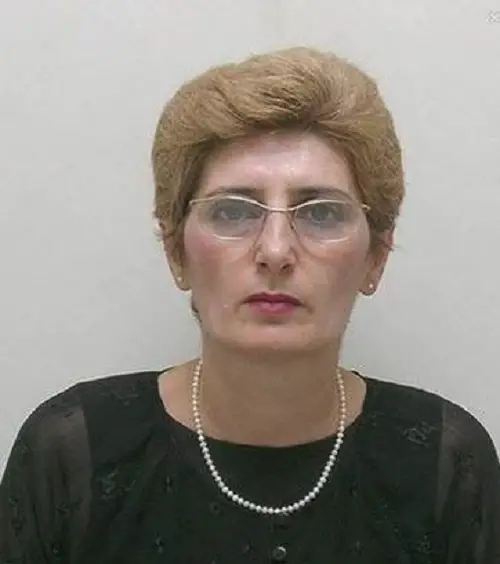

Memorie.al / Laureta Petoshati, known today as a representative of Vlora women in the field of culture and art, has presented the Albanian world with the voluminous novel “Return to Ventotene,” dedicated to: “All those who were persecuted by dictatorships,” with an appreciative preface by Dr. Alisa Velaj. Laureta was born in the coastal city of Vlora and graduated from the University of Tirana as a hydro-engineer. She experienced the difficult life of an emigrant in the USA, but the difficulties did not defeat her. There, she is one of the founders of the cultural-patriotic association “Bijtë e Shqipes” (Sons of the Eagle), based in Philadelphia, and one of the first initiators for opening a school in the Albanian language.
She is an activist for the national cause, for the freedom of Kosovo, participating in demonstrations and giving interviews on Radio-ABC in the Italian language. She reflected the association’s activities, as well as her thoughts and ideas, in the Albanian-American newspaper “Illyria.” In 2005, she returned to Albania but continued her correspondence with this prestigious newspaper.
Currently, Laureta is a well-known publicist, publishing in many newspapers and magazines, inside and outside the country, such as: “Jeta Arbëreshe” and “Rrënjët” in Italy, “Ndryshe,” “Nacional,” “Republika,” etc., in Albania. In Vlora, she was first a journalist and then the editor-in-chief of the newspaper “Vlora,” as well as a journalist for the ‘Vlora Channel’ television. Literature and journalism have been and remain not only a passion but also a mission in her life.
She published her first book, “Perëndesha e Parajsës” (Goddess of Paradise), a poetry collection, at the beginning of 1997. Laureta is also known as a translator, knowledgeable in four foreign languages, among which Italian and English stand out. She has received three national first prizes for translating poems into Albanian from Italian and English, and from Albanian into English.
In 2008, she was honored by the Pan-National Cultural Association “Ismail Qemal-Vlora” with the title “Distinguished Personality of Pan-National Culture.” Her study on the new literary current born in Albania, which she named “Spiralism,” has been published in several newspapers, both domestically and abroad. She has three other books in the process of publication: the poetry volume “Spirale,” literary and art criticism for contemporary authors, and journalism and reportage.
The voluminous historical-literary novel we will analyze, “Return to Ventotene,” was published at the end of 2012. While Dante Alighieri speaks of real characters who went to hell for their sins, Laureta Petoshati, in this novel, speaks of those condemned to the hell of Ventotene who are there for high motives: for freedom and social justice, the fight against oppression and exploitation.
Although the novel covers a long period in Albanian history, Laureta Petoshati focuses on the years of World War II and introduces us to real events and characters that lived during those difficult years. Her starting point is her hometown, the city of Vlora.
The beauty of the novel lies in the fact that the author takes as her starting point not a single character, but an entire family, the Leka family, originally from Mbishkodra, residing in Vlora after the head of the family, Zef Leka, an Albanian language teacher, was appointed there by Luigj Gurakuqi, two years before the heroic Vlora War of 1920. Zef’s entire family had been wiped out by Serb-Montenegrin chauvinism in defense of their lands, and thus the orphaned Zef was raised and educated by the Franciscans.
Pali, Zef’s eldest son, rose in a patriotic and religious environment, without racial or religious distinctions, actively participates in demonstrations against the fascist occupation of Albania and is arrested. After court proceedings, he is interned on the island of Ventotene in Italy, then in the Arezzo d’Angari concentration camp, and after this camp; he is taken by the Germans who exploit him and many other Albanians and Italians for their military constructions.
Everywhere he goes, Pali keeps hidden several handwritten pages given to him by an Albanian friend in Ventotene: The Ventotene Manifesto, which speaks of the unification of Europe, was drafted by several Italian intellectuals in cooperation with some Albanians, such as Llazar Fundo and Stavro Skëndi. The Albanian intellectuals became part of the debate, exchanged ideas, but the conditions of their occupied country posed the main task of liberating the country, establishing democracy, and then realizing the unification of Europe.
Moreover, due to the emergence of the Atlantic Charter, which spoke of the self-determination of peoples, Llazar Fundo, who was the closest friend in Ventotene to Altiero Spinelli, who is today called the Father of a United Europe, did not sign. He was the first to foresee what would happen in Kosovo and Chameria, so it is no coincidence that Isuf Luzaj, who had known him early in France and later during his internment in Ventotene, calls him; “the greatest philosopher the Albanian race has ever had.”
The book fills you with abundant information, as Laureta has managed, rationally and without tiring the reader, to extract interesting events and characters from the dust of time and bring them to our days, through a surprising originality, which has caused an unusual wonder for her courage to tell the events and the people who constituted them, exactly as they were.
In Ventotene, Pali meets people who would later become leaders of war, state, and humanist ideals, such as; Sandro Pertini, Altiero Spinelli, Eugenio Colorni, Ernesto Rossi, Giorgio Braccialarghe, Luigi Longo, etc. But through narration and contacts, he also gets to know great Albanians, in mind and deeds, regardless of political convictions.
The author talks about the era of fascism, Nazism, and even Stalinist communism. In such a way that the world becomes so small and people of different cultures, languages, and nations connect in friendship and get to know each other through the joint struggle against these plagues of humanity. These people of suffering, “Eagles” of freedom, are united by a common goal, mutual recognition, despite being different from each other in culture, family, and national history.
The Importance or what new things this novel brings us?
Dr. Alisa Velaj expresses the main idea and importance of this novel by Laureta Petoshati with these words, which are also published as the preface to the novel: “Attempting to reconstruct the history of a nation through literature is undoubtedly an act as high as it is extremely complicated. Laureta Petoshati has masterfully managed to realize this entire process.”
The novel “Return to Ventotene” is the fruit of years of laborious, investigative work in the field of history and, moreover, in the investigation and tracing of the efforts of Albanian intellectuals during the period of World War II, mainly those interned by fascism on the islands of Italy, as part of the debate for the drafting of the historical document of the “Ventotene Manifesto,” which would be the core of realizing the dream of a United Europe.
This mosaic of Albanian life in interaction with other nations and peoples for more than a century embodies the great drama of our nation throughout history, dramas caused by the political mistakes of the time they occurred, but also dramas caused by the Albanians themselves!
Laureta Petoshati reintroduces this theme, shifting it in parallel to Ventotene and Renicci di Anghiari in Arezzo, between the lives of the internees of various nationalities and the urban life of Vlora, where coexistence between locals, Italians, and Jews was excellent.
“The communist dictatorship in its beginnings constitutes one of the deepest analyses of this novel.”
This is how Dr. Velaj defines the idea of this novel. If you read the novel carefully, you see that we are dealing with an original literature that expresses a deep and multi-faceted culture. The author investigates without compromise and pursues the truth to the end, utilizing not only archives, books, and memoirs of historical figures but also her abilities as an investigative journalist, and she tries to present this truth through a highly original style and a vocabulary that intertwines both the everyday speech of simple people and the most sophisticated and philosophical nuances of her characters.
The very description of life in Ventotene speaks of a polyhedral world and open minds that ponder and reflect on their future, as well as that of the continent. After the end of World War II, everyone returns to their homes, but Pali does not. The history of this family is intertwined with the lives of several other families in Vlora and Albania, and the author gives a detailed description of the dictatorial regime of Enver Hoxha, which was established by violence and bloodshed.
It is a type of narrative whose main goal is the extraction of historical truth to the maximum possible extent, and precisely this truth can be considered the message of the work, a clear message for all readers. At times, due to the erudition of the work, the author Laureta Petoshati addresses a select reader, as we have a work with rich, complex, and deep information, described at times with psychological realism.
Throughout the book, in almost all events, the sea is present as an accompaniment; naturally, a Vlora native cannot understand the world without the sea, boundless and endless, as Maxim Gorky said, that sea which has also made the author’s soul broad and deep. The colors of the sea transmit the emotional states of the characters and give vivacity to the description. In the sea, one sees the love for life and freedom, the space that gives peace and happiness.
Magical landscapes, slippery like lights on the water, prayers that connect man to God with love, tenderness, and hope where many can shudder, even be shaken, when reading the novel “Return to Ventotene,” by the writer from Vlora, Laureta Petoshati, who knows how to say things plainly and without fear and knows how to remain faithful to history, intertwined so beautifully with modern literature.
Why did Laureta Petoshati title her novel, “Return to Ventotene”?!
It is a return to the old dream of Albanians to enter a united Europe, a dream reflected in the “Ventotene Manifesto,” which the main character of the novel, Pali, had hidden inside that jacket stained with bullets, and which came to Albania after the fall of the dictatorship.
What was the fate of the historical figures, the internees of Ventotene?
The author fulfills this reader curiosity with the epilogue at the end of the book. Some of the internees in Ventotene during the years 1939 – 1943 are listed at the end of this writing. The novel has nearly 600 pages. The cover features the well-known statue, “The Wheel of Life” (Wheel of life, Monolith statue, Vigeland Park, Oslo Norway), which gives meaning to the content of the novel.
Some of the internees in Ventotene, during the years 1939 – 1943, who are characters in Laureta Petoshati’s novel, “Return to Ventotene.”
All condemned and persecuted by the communist dictatorship!
- Llazar Fundo: Barbarically beaten and dragged behind a horse by the legendary criminal, Shefqet Peçi, who executed him without trial.
- Stavro Skëndi: Declared an enemy of the people by the communists, he fled to the USA, where he worked as a university professor.
- Isuf Luzaj: Declared an enemy of the people, he fled to the USA, where he worked as a professor at several universities.
- Fazlli Frashëri: Executed without trial.
- Selman Riza: Distinguished scientist and linguist, he was sentenced to prison by Albanian and Slavic communists. He was persecuted until the end of his life.
- Safet Butka: Unable to witness and accept the fratricidal war declared by the communists in 1943, he committed suicide.
- Izet Bebeziqi: Sentenced to prison and persecuted throughout his life.
- Abaz Ermenji: Declared an enemy of the people, he fled to France where he worked as a literature professor.
- Ndue Pali: Executed as an anti-communist.
- Myzafer Pipa: Died under torture, without being brought to trial.
- Sinan Gjoni: Executed by order of Enver Hoxha.
- Gani Kryeziu: Tortured and died in the prisons of former Yugoslavia by the Tito-Ranković clique.
- Hasan Kryeziu: Executed by the Tito-Ranković clique.
- Said Kryeziu: Fled to Italy and then to the USA.
- Zef Mala: Imprisoned and interned several times by order of Enver Hoxha.
- Mandi Koçi (“Maku”): Sentenced to 30 years in prison by order of Enver Hoxha. He was unable to start a family and died alone in an elderly care home.
- Abdurrahman Kreshpa: Still a young man when interned in Ventotene, and after the age of 20, he was sentenced and imprisoned several times by the communists of Vlora. (The list continues…!) Memorie.al