• Rreth Nesh
  • Kontakt
  • English
Thursday, January 22, 2026
Memorie.al
No Result
View All Result
  • Home
  • Dossier
  • Interview
  • Personage
  • Documentary
  • Photo Gallery
  • Art & Culture
  • Sport
  • Historical calendar
  • Others
  • Home
  • Dossier
  • Interview
  • Personage
  • Documentary
  • Photo Gallery
  • Art & Culture
  • Sport
  • Historical calendar
  • Others
No Result
View All Result
Memorie.al
No Result
View All Result

“Daut Kanan Aliaj from Gorishti, Vlora, was arrested by the Sigurimi one day before the elections, after declaring that on voting day, he…”! / A sad story from the “elections” in communism, April 1977

“Një dëshmitar, i identifikuar si J., ishte arrestuar në vitin 1986, pas refuzimit të votës për kandidatin lokal të Partisë Komuniste, u dënua 10 vjet burg, pasi…”/ Shkrimi i New York Times, në 21 janar ‘90
“Në kasafortën e kreut të Sigurimit të Shtetit, u gjetën monedha e dhëmbë floriri, unaza, bizhuteri dhe…”/ Historiani dhe studiuesi i njohur, publikon dokumentin e rrallë
21 prill 1921, kur hapej Parlamentit i parë / Historia e panjohur e zgjedhjeve dhe votimeve në Shqipëri: nga dy parti në 1921-’24-ën, te Zogu dhe ato me gogla e një kandidat të Enverit

By Kastriot Dervishi

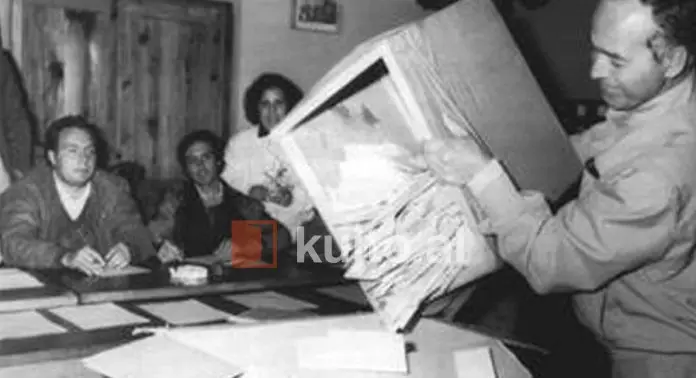
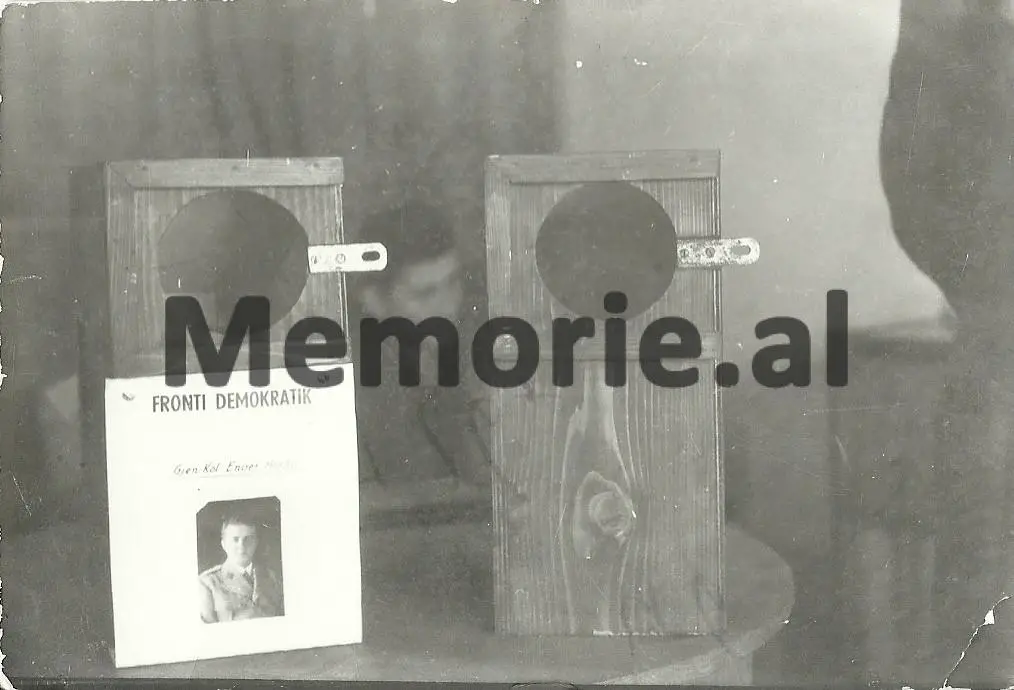
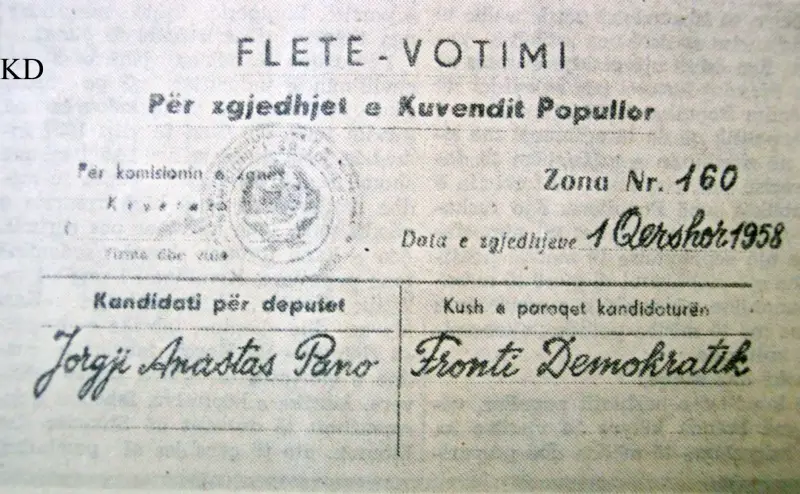
Memorie.al / On 3.4.1977, the next elections for the people’s councils and people’s courts were held in Albania. In these elections, candidates from the Democratic Front list were formally voted for, lists that had been previously approved by the Labor Party in its forums. The voter took the ballot and put it in the box without making any changes. After the elections were over, the elected councilors voted for the executive committee of the district or city, along with their mayors, on a ready-made list that came from the party. District judges were also called to vote, with the same list that came from the party.

Elections under communism had a pronounced formal character, but a very strong propaganda and festive one. The regime mobilized its entire apparatus so that that Sunday would be as festive as possible, the elections would end quickly and the participation would be 100%. Prisoners did not have the right to vote.

In some cases, election days were seen as a sign of protest by people who were dissatisfied. They tended to express this mainly by not participating in the elections, as a sign of pressure on the government to solve some family problem, such as housing, employment, etc.

Gjithashtu mund të lexoni

“Anyone who brings about public terror, causes disturbances and disorders, detonates or sets dynamites, explosives, bombs, lethal or incendiary machines, shall be punished…” / What did the Penal Code of 1928 provide for?

“Minister Hazbiu, a childhood friend of mine, called me to his office in prison and said: ‘Petrit, I want to help. I can release you as soon as tomorrow if you come to work for us; we’ll even send you abroad’…” / The extraordinary account of a legend of the communist prisons.

Some others, in the heat of the moment, also took bold actions that could be treated as agitation and propaganda, despite the fact that they did not constitute a crime, according to the Criminal Code.

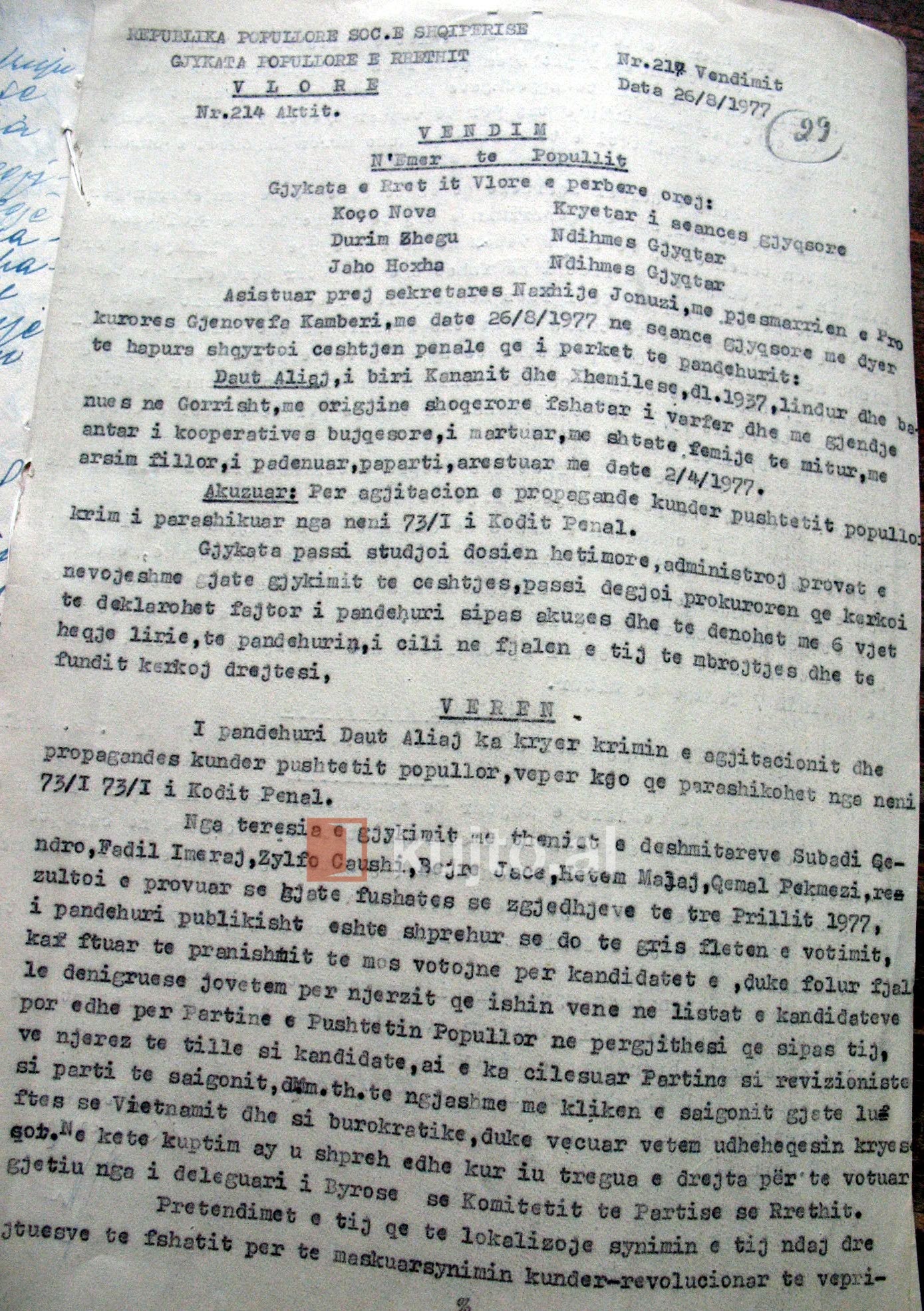
Daut Kanan Aliaj, born in 1937, born and residing in Gorisht, Vlorë, member of an agricultural cooperative, father of 7 minor children, was 40 years old when he was arrested on 2.4.1977 (one day before the elections). He was accused under Article 73/1 of the Criminal Code, i.e., for “agitation and propaganda against the people’s government”. In the trial, 6 witnesses came forward.

It was considered that his fault was that during the election campaign, he had said that he would tear up the ballot paper, inviting those who heard him not to vote, throwing words against the people who made up the Democratic Front list, especially those from his village. Dissatisfied with the names, he had described the Labor Party as revisionist.

For this reason, since the voter did not have the right to make other choices, the delegate of the bureau of the Vlora District Committee of the Party of Labor had invited him to vote in another area.

The gesture of tearing up the ballot paper was considered “counter-revolutionary”, while the court assessed that “clarification work” had also been done with the defendant.

The People’s Court of Vlora District, with decision no. 214, dated 26.8.1977, declared him guilty and sentenced him to 6 years of imprisonment and deprivation of the right to vote for 3 years. He was released under amnesty on 15.11.1982.

Elections under communism, with one candidate!

Throughout the existence of their regime, from November 1944 until the collapse of that system in the early 1990s, the Party of Labor never competed as an electoral subject.

It hid behind the Democratic Front. Elections were held for the People’s Assembly (every 4 years) and elections for local government (people’s councils of cities and villages) and people’s courts (every 3 years).

There was only one candidate on the voters’ lists, nominated in the name of the Democratic Front, previously approved by the structures of the Labor Party: the Political Bureau for the legislative body and the party committees for the people’s councilors. The voter did nothing, but only put the ballot in the ballot box.

The elections opened at 7:00 and until 8:00, all the Labor Party branches in the neighborhood competed for participation in the elections (the only competition). Everywhere there was a party and radio, which gave a tragicomic character to the day when the walk, which was called “election” was supposed to take place! Memorie.al
ShareTweetPinSendShareSend
Previous Post

"From Manhattan to the boulevard of Tirana and the meetings with Ramiz Ali and Nexhmije Hoxha, who asked for..."! / The story of Shaqir Gashi, who lobbied for Congressman Tom Lantosh and the war for Kosovo 

Next Post

"Hasija was my sister, and Hamit was her sister's husband, and we always got along well, but the last day they left the house..."/ Testimony of Bukurie investigator Xhemal Xhaferi 

Artikuj të ngjashëm

“Anyone who brings about public terror, causes disturbances and disorders, detonates or sets dynamites, explosives, bombs, lethal or incendiary machines, shall be punished…” / What did the Penal Code of 1928 provide for?
Dossier

“Anyone who brings about public terror, causes disturbances and disorders, detonates or sets dynamites, explosives, bombs, lethal or incendiary machines, shall be punished…” / What did the Penal Code of 1928 provide for?

January 22, 2026
“Minister Hazbiu, a childhood friend of mine, called me to his office in prison and said: ‘Petrit, I want to help. I can release you as soon as tomorrow if you come to work for us; we’ll even send you abroad’…” / The extraordinary account of a legend of the communist prisons.
Dossier

“Minister Hazbiu, a childhood friend of mine, called me to his office in prison and said: ‘Petrit, I want to help. I can release you as soon as tomorrow if you come to work for us; we’ll even send you abroad’…” / The extraordinary account of a legend of the communist prisons.

January 21, 2026
“Julian Amery wrote in his memoirs; while other exiled Kings were inseparable from London’s nightclubs, Zog rarely appeared in public, because…” / The unknown history of King Zog in England.
Dossier

“Julian Amery wrote in his memoirs; while other exiled Kings were inseparable from London’s nightclubs, Zog rarely appeared in public, because…” / The unknown history of King Zog in England.

January 21, 2026
“As Hariton was being led to his execution, he quietly marked the page of the book he was reading and followed the officers… / The tragic story of the Bezhani family, founders of Vlore’s first bank in 1850.”
Personage

“As Hariton was being led to his execution, he quietly marked the page of the book he was reading and followed the officers… / The tragic story of the Bezhani family, founders of Vlore’s first bank in 1850.”

January 21, 2026
Calendar January 1, 2026
Historical calendar

Calendar January 22, 2026

January 19, 2026
“In the book ‘History of Albanian Literature,’ there are many untruths, slanders, and insults regarding Faik Konica, labeling him as; ‘reactionary,’ ‘unscrupulous,’ ‘mystical,’ etc…!” / Reflections of the renowned publicist.
Personage

“In the book ‘History of Albanian Literature,’ there are many untruths, slanders, and insults regarding Faik Konica, labeling him as; ‘reactionary,’ ‘unscrupulous,’ ‘mystical,’ etc…!” / Reflections of the renowned publicist.

January 22, 2026
Next Post
“Hasija was my sister, and Hamit was her sister’s husband, and we always got along well, but the last day they left the house…”/ Testimony of Bukurie investigator Xhemal Xhaferi 

"Hasija was my sister, and Hamit was her sister's husband, and we always got along well, but the last day they left the house..."/ Testimony of Bukurie investigator Xhemal Xhaferi 

“Historia është versioni i ngjarjeve të kaluara për të cilat njerëzit kanë vendosur të bien dakord”
Napoleon Bonaparti

Publikimi ose shpërndarja e përmbajtjes së artikujve nga burime të tjera është e ndaluar reptësisht pa pëlqimin paraprak me shkrim nga Portali MEMORIE. Për të marrë dhe publikuar materialet e Portalit MEMORIE, dërgoni kërkesën tuaj tek [email protected]
NIPT: L92013011M

Na ndiqni

  • Rreth Nesh
  • Privacy

© Memorie.al 2024 • Ndalohet riprodhimi i paautorizuar i përmbajtjes së kësaj faqeje.

No Result
View All Result
  • English
  • Home
  • Dossier
  • Interview
  • Personage
  • Documentary
  • Photo Gallery
  • Art & Culture
  • Sport
  • Historical calendar
  • Others