
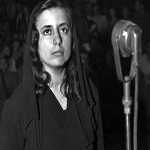
 1917 – Musine Kokalari, a 20th-century Albanian political and cultural activist and writer, was born in Adana. In 1937, she graduated from the “Nana Mbretneshë” Women’s Institute and then continued her studies at the University of Rome, in Italy, which she graduated with honors in 1941. Together with Mit’hat Aranit and other friends, she founded the Social Democratic Party in 1943. On November 12, 1944, the brothers Muntaz and Vejsim Kokalari were shot without trial. She was arrested on January 17, 1946 and held for 17 days in prison. On July 2 of the same year, she was sentenced to 20 years in prison by the Tirana military court as a saboteur and enemy of the people. In 1964, after 18 years of imprisonment in Burreli Prison, isolated and under surveillance, she spent the next 19 years of her life interned in Rrëshen. Musineja worked as a sweeper and 11 years in the Construction Company in Rrëshen, among bricks, mortar and concrete. When her internment ended in 1979, she was told to go to Gjirokastër, but after they did not allow her to go to Tirana, she refused to move from Rrëshen. She died on August 13, 1983.
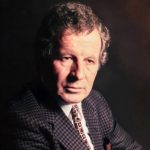 1938 – Azem Shkreli, an Albanian poet and literary critic, was born in Rugova, Peja. He was the president of the Kosovo Writers’ Association, the director of the Provincial Theater in Prishtina and the founder and director of Kosova Film. With his literary creativity he appeared in the ’50s and with his poetry he set poetic peaks in Albanian literature. His poems have been translated into many foreign languages. Azem Shkreli’s emergence as a poet, in addition to coinciding with the arrival of powerful talent, also marked the first turn towards the opening and modernization of post-war Albanian poetry. Shkreli naturally climbed to the heights of today’s Albanian poetry and this place he consolidated and reinforced from one poetic work to another, until the last one, which left the manuscript “Birds and stones”, published in 1997.
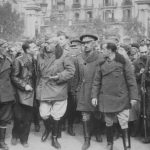 1939 – During the Spanish Civil War, nationalists complete their takeover of Catalonia and seal the border with France. The Nationalist Army launched the offensive on December 23, 1938, and quickly occupied Republican-held Catalonia with Barcelona, the capital of the Republic, from October 1937. This would be the final phase of this bloody four-year civil conflict.
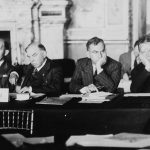 1947 – The Paris Peace Treaties are signed by Italy, Romania, Hungary, Bulgaria, Finland and WWII Allies. The Peace Conference in Paris lasted from July 29 to October 15, 1946. The treaties allowed the defeated Axis powers to regain their responsibilities as sovereign states in international affairs and to qualify for membership in the United Nations.
 1950 – Born in Modesto, Mark Spitz. Spitz is a former competitive American swimmer and 10-time Olympic champion. He won seven gold medals at the 1972 Summer Olympics in Munich, all on a world record. It was an achievement that lasted for 36 years until it was surpassed by US colleague Michael Phelps, who won eight gold medals at the 2008 Beijing Olympics.
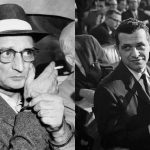 1962 – During the Cold War, captured U2 spy pilot Gary Powers exchanges with captured Soviet agent Rudolf Abel. Along with Powers, American student Frederic Pryor was also exchanged. The famous exchange took place in the wee hours of the night on the main Berlin Glikopeni Bridge. Even today, because of the exchanges, this bridge is called the “spy bridge”.
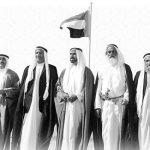 1972 – Ras Al Khaimah joins the United Arab Emirates, currently comprising seven emirates. The leader of the province, Sadr bin Muhammad Al Qasimi, joined Ras Al Khaimah with official Abu Dhabi because of the constant threat of US, Russian, or other Middle Eastern military power seizing the coast. The formation of the UAE stabilized the situation in this region.
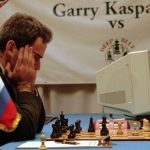 1996 – IBM’s Deep Blue supercomputer defeats Garry Kasparov for the first time in chess. It was designed to be the first computer game system to win a chess game and a chess match against a reigning world champion under regular time controls. This would be one of the rare victories in the world of an electronic application against a chess player.
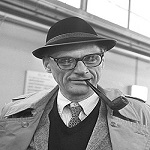 2005 – Arthur Miller dies, was one of the giants of world literature of the 20th century, known as the “conscience of the American stage”. He did not simply write plays, but performed an autopsy of society and the human spirit. From 1934, Miller studied journalism and English language and literature at the University of Michigan. In addition to his studies, he worked, among other things, as a reporter and laboratory assistant. After completing his studies in 1938, Miller wrote pieces for listening and acting. In 1945, his novel The Crucible was published, which made Miller known as a storyteller.